
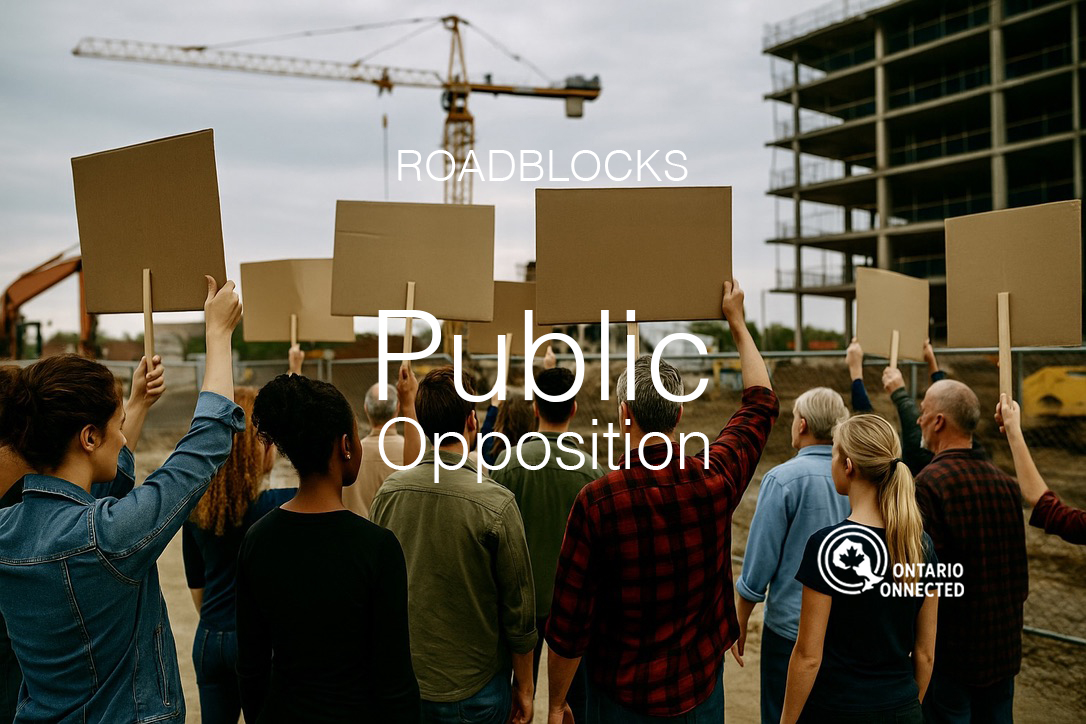
Public Opposition: When the Loudest Voices Stall Everyone Else’s Future
In Ontario, public opposition has become one of the most effective ways to stop a project without ever touching a budget line or a shovel. A handful of angry residents can pack a gymnasium, flood a councillor’s inbox, or launch a Facebook group—and suddenly a transit stop, housing project, or shelter is “on hold for further study.” On paper, it looks like “community input.” In reality, this kind of public opposition often means thousands of people lose out so that a few can keep things exactly as they are.
You can see the pattern across the province. A new transit line meant to relieve crushing commutes gets rerouted after a small group complains about noise and shadows. A mid-rise housing project near a station is cut in half because neighbours don’t like “the look of it.” A supportive housing project is quietly killed after a loud minority paints it as a threat. Meanwhile, everyone else keeps paying the price in rent, time, and stress.
We talk a lot about bureaucracy and rising construction costs as roadblocks. Public opposition is the quieter one—the one that smiles, says “we support transit and housing,” and then fights every single place it might actually go.
Why Public Opposition Takes Over the Conversation
Most people don’t have time to attend every town hall or write long submissions. They’re working, commuting, taking care of kids, or just trying to survive the week. The people who show up again and again are often the ones with time, money, and something to protect. That’s how public opposition ends up sounding larger than it really is.
- Fear of change: Even small projects—bike lanes, mid-rise apartments, a redesigned intersection—are painted as “ruining the neighbourhood.”
- Property value panic: Any new building becomes a threat, regardless of whether data supports the fears.
- Misinformation: Rumours spread faster than fact sheets. A bad Facebook post travels further than any official notice.
- Distrust: After years of delays and broken promises on other files, people assume every new project is a scam or a lie.
Local meetings are supposed to be about balancing concerns and benefits. Instead, they often become venues where public opposition dominates the microphone while the people who would benefit most—renters, shift workers, future transit riders—are barely in the room.
Public Opposition in Practice
Picture a community centre on a weeknight. At the front of the room, city staff try to present a new transit stop or housing proposal. In the seats, the pattern is painfully familiar: the loudest voices sit in the front row, ready with printed signs and speeches. They say they support transit “in principle,” but not here. They’re not against housing, “just this building.” They’re not opposed to shelters, “as long as it’s somewhere else.”
Meanwhile, the people who would gain the most—bus riders who stand in the cold, parents who need child care nearby, young adults priced out of the area—either aren’t there, or sit quietly at the back. Public opposition wins by volume, not by representing the broader public.
The Cost of Public Opposition on Ontario Projects
Every time a project is delayed to “consult more,” the realities of Ontario’s other roadblocks get worse. Delays feed labour shortages. They feed cost escalation. They feed frustration and cynicism. A project that could have been built for one price in 2022 becomes unaffordable by 2027, and the same people who fought it then complain later that “government can’t get anything done.”
- Transit: Fewer lines, fewer stops, and more overcrowding because routes are watered down to appease a small group.
- Housing: Fewer units, shorter buildings, or cancelled projects mean higher rents and more people pushed out of their communities.
- Health and social services: Shelters, clinics, and supportive housing delayed or killed entirely while need keeps growing.
Public opposition doesn’t just slow individual projects—it distorts priorities. Politicians learn to fear the loudest twenty residents in a room more than the tens of thousands silently struggling outside it.
Consultation Without Surrender
Public input matters. People who live near a project do see real impacts that should be addressed. But there’s a difference between consultation and surrender. Listening is not the same as handing veto power to whoever has the time to shout the longest.
- Be honest about trade-offs: More housing means more people and more activity. Better transit means more trains and buses. You can’t have the benefits without any visible change.
- Give space to the missing voices: Outreach should actively include renters, shift workers, newcomers, and youth—not just the retirees with time to attend every meeting.
- Correct misinformation quickly: When rumours spread, clear maps, data, and timelines should be easy to find and easier to share.
- Make the regional case: A single neighbourhood doesn’t own a transit line or hospital. These projects serve whole cities and regions.
Ontario’s own consultation channels, like the ones listed on the provincial consultations page, show how many decisions affect entire regions, not just one block or one street.
Whose Future Are We Protecting?
Public opposition often dresses itself up as “protecting the neighbourhood.” The question is: protecting it for whom? For the people already comfortably housed, already close to transit, already stable—or for the people trying to get there?
If every project dies in a gymnasium full of angry residents, Ontario will stay stuck in the same loop: high rents, long commutes, overcrowded services, and a politics that rewards saying “no” louder than anyone else. Real consultation means hearing concerns and improving projects. It does not mean letting public opposition bury every attempt to build a better future.
That’s why this Roadblocks series keeps coming back to the same theme: delays—whether from bureaucracy, politics, or public opposition—don’t protect communities. They quietly make life harder for the people who need change the most.






Leave A Comment
You must be logged in to post a comment.