
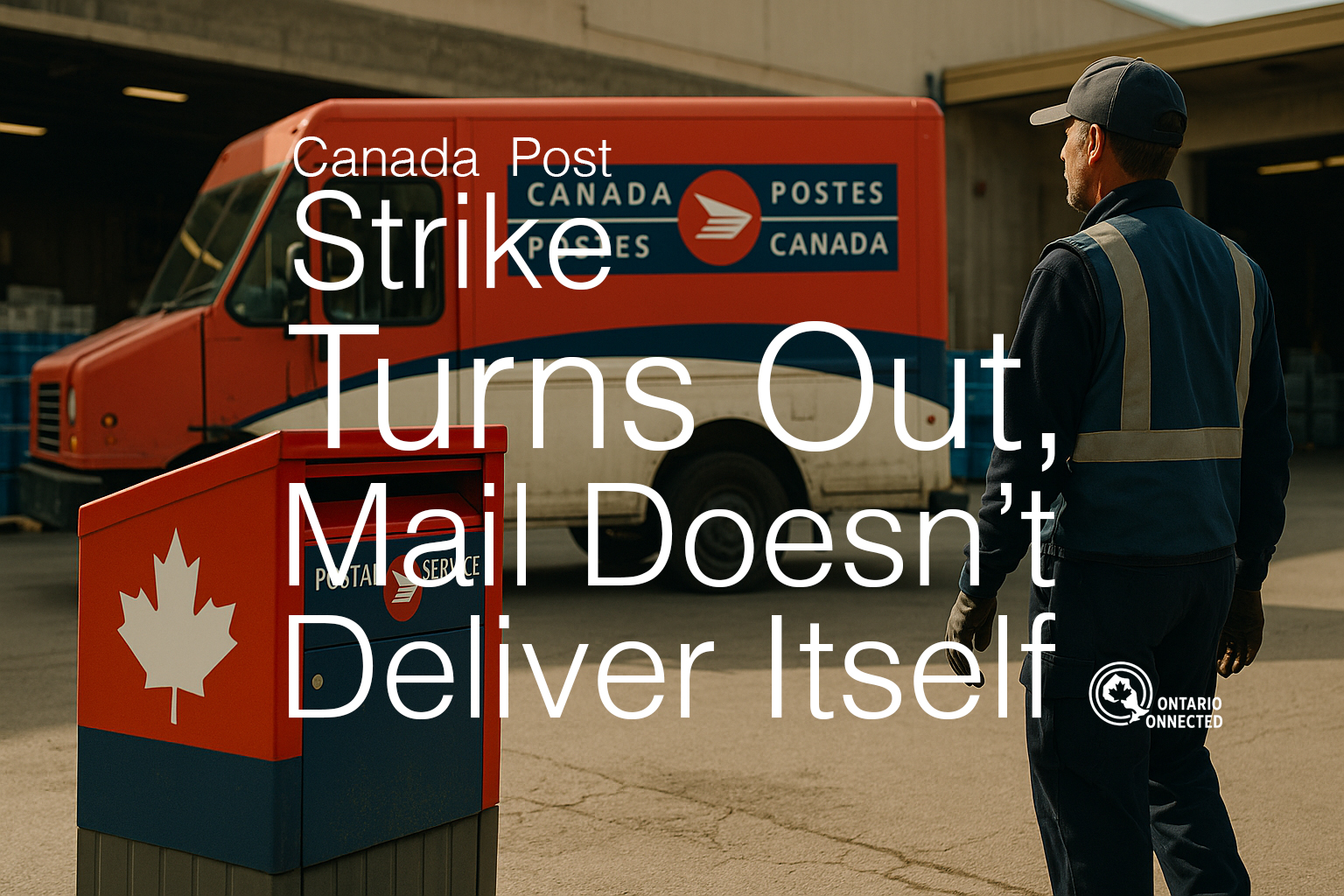
The Canada Post strike is back in the headlines again: workers on the line, parcels stuck in limbo, and a national service that everyone assumes will somehow keep running on fumes, goodwill, and a couple of lukewarm coffees.
Every time the Canada Post strike hits, the script feels familiar. People worry about gifts, online orders, documents and cheques that may or may not arrive before they matter. Comment sections light up with complaints about “lazy workers” and “greedy unions,” as if the real problem is the people holding the whole structure together.
But the Canada Post strike is not the real shock. The real shock is how fragile our public services have become — and how quickly people forget who is actually keeping them upright.
Canada Post Strike: More Than Delayed Parcels
On paper, the Canada Post strike is about wages, benefits, and working conditions. In reality, it is about whether Canadians still want universal, reliable public services or are quietly willing to trade them away in exchange for “faster” or “cheaper” private options.
Canada Post is not just another parcel company. It is federal infrastructure. It connects small towns, remote communities, northern regions, and big cities with the same network. No private courier is lining up to deliver a single envelope to a rural address 40 minutes off the highway in January at a sane price. That happens only when we treat mail as a public service, not a business experiment.
Yet instead of asking why the system is underfunded, understaffed, and overloaded, it is easier to blame the Canada Post strike on workers who finally refuse to quietly absorb more pressure. Convenient. Also wrong.
Essential Workers: Same Story, Different Uniforms
If you look past the logo on the truck, the pattern around the Canada Post strike is painfully familiar. Postal employees, transit workers, mechanics, paramedics, hydro crews — the job titles change, but the pressures barely do:
- More work crammed into the same or fewer hours.
- Staffing levels that never quite match the real workload.
- Rising public expectations and zero tolerance for delays.
- Safety risks quietly becoming “part of the job.”
- Management chasing “efficiency” while people burn out.
In that environment, unions are not a perk. They are the only barrier between “barely manageable” and “completely unlivable.” Take away the protections and the work does not get easier; it just breaks people faster.
And once enough people break, the service breaks with them — whether it is a Canada Post strike, a transit disruption, or a paramedic system in constant code red.
How Strong Unions Keep Public Services Standing
The Canada Post strike is a reminder of what happens when that barrier is the last thing holding the line. Without strong unions, essential workers get squeezed until something gives — usually their health, their family life, or their job.
Unions in any essential service, including transit, fight for things most customers never see, such as:
- Safe staffing levels so corners are not cut “to make service.”
- Scheduling rules so people are not worked into exhaustion.
- Protections after assaults, injuries, or traumatic incidents.
- Health benefits that reflect the real damage the job can do.
- Job security so workers are not living one bad contract away from chaos.
The public only sees the final product: the mail arriving, the bus or train showing up, the lights staying on. What they never see is the union language that quietly stops reckless cost-cutting and bad policy from becoming “normal.”
When that union language is weakened, the cracks show up first as things like the Canada Post strike — short-term disruption that exposes long-term neglect.
Reading the Canada Post Strike Through the Eyes of Transit Workers
Transit workers do not need anyone to explain what the Canada Post strike feels like. Long shifts, tight schedules, unpredictable traffic, winter weather, mechanical issues, short turns, angry passengers — and through all of it, the expectation that service will somehow stay smooth and on time.
For operators, mechanics, and other transit workers represented by ATU Local 113, the union’s role is not academic. It is built into everyday life, even for those who only notice it when negotiations heat up.
No one thinks about clauses around bathroom breaks until they are stuck in gridlock with a full bus and a full bladder. No one thinks about assault protections until a passenger crosses the line. No one thinks about medical coverage until their body or mind starts paying the price of years of shift work.
Those protections do not appear by accident. They exist because a union stands there saying, “No, this is not acceptable,” while everyone else is trying to shave costs or pretend the problem doesn’t exist. The Canada Post strike is just the version of that fight happening in another uniform.
Families Feel the Impact Long Before the Public Does
It is easy to see the Canada Post strike as an “inconvenience” for shoppers and businesses. It is less easy to see it as a survival issue for workers and their families — but that is exactly what it is.
Behind every postal worker or transit worker is a family depending on:
- Stable income that keeps up with the cost of living.
- Predictable schedules that allow people to actually see their kids.
- Health benefits that cover injuries, stress, and long-term wear and tear.
- Job security that makes a mortgage or rent remotely possible.
When unions are weakened or attacked, it is not just a “labour issue.” It is housing, mental health, child poverty, and community stability rolled into one. Workers do not go home from a bad shift and hang their stress in the closet with their uniform. It follows them.
When enough families are pushed to the edge, the damage does not stay inside the depot, the garage, or the division. It leaks into everything.
Privatization: The Quiet Exit Ramp from Canada Post
One of the biggest risks of repeated Canada Post strike cycles is the slow shift of public trust toward private companies. People frustrated with delays try a courier “just this once,” discover that yes, it is more expensive but predictable, and next year they do not even bother with the public option.
Once habits change, support for funding the national service erodes. “Why are we paying for this if I can just use a private company?” becomes an easy political talking point. That is how you slide, step by step, from a universal public service to a patchwork of private solutions where the most vulnerable communities are simply not worth serving.
The same risk exists in transit and other public systems. Starve them, understaff them, blame workers for every failure, then act shocked when someone suggests privatization as the cure. The Canada Post strike shows exactly where that road leads if we pretend not to see it.
Ontario Connected: Public Services as Real Infrastructure
Ontario Connected is built on a simple idea: if we want a province that works, we have to treat public services as real infrastructure, not disposable line items. That includes mail, transit, energy, health care, and the people who run all of it.
The Canada Post strike is not just a postal dispute. It is a case study in what happens when an essential service is stretched until it snaps — and how unions are often the last barrier between “strained but functioning” and “broken beyond repair.”
If we want reliable service for Canadians, especially during high-demand periods like the holidays, we cannot pretend the solution is to weaken the very people delivering it. A stable postal system, just like a stable transit system, depends on:
- Consistent long-term public investment.
- Modernized infrastructure that keeps up with demand.
- Fair agreements that respect workers’ limits and needs.
- Strong unions that are allowed to do their job: protecting people so the service does not fall apart.
That is the real connection between the Canada Post strike and every other essential service, from depots to divisions. The logo changes. The pattern doesn’t.
If We Ignore the Canada Post Strike, We Already Know the Ending
The Canada Post strike is giving us an early look at where things are headed if we keep demanding cheaper, faster, “more efficient” public services while quietly squeezing the workers behind them.
Cut protections and the work collapses.
When the work collapses, families take the hit.
When families are pushed to the limit, the service breaks — and then everyone acts surprised.
We do not all have to agree on unions. We do not have to cheer every strike or every tactic. But if we say we care about reliable public services, fair treatment, and families keeping a roof over their heads and food on the table, then we cannot cheer for the service while cheering against the people who make it possible.
The Canada Post strike is not just another labour headline. It is a warning. And if we are honest, most of us working in other public services can already see ourselves somewhere between the lines.



Leave A Comment
You must be logged in to post a comment.