
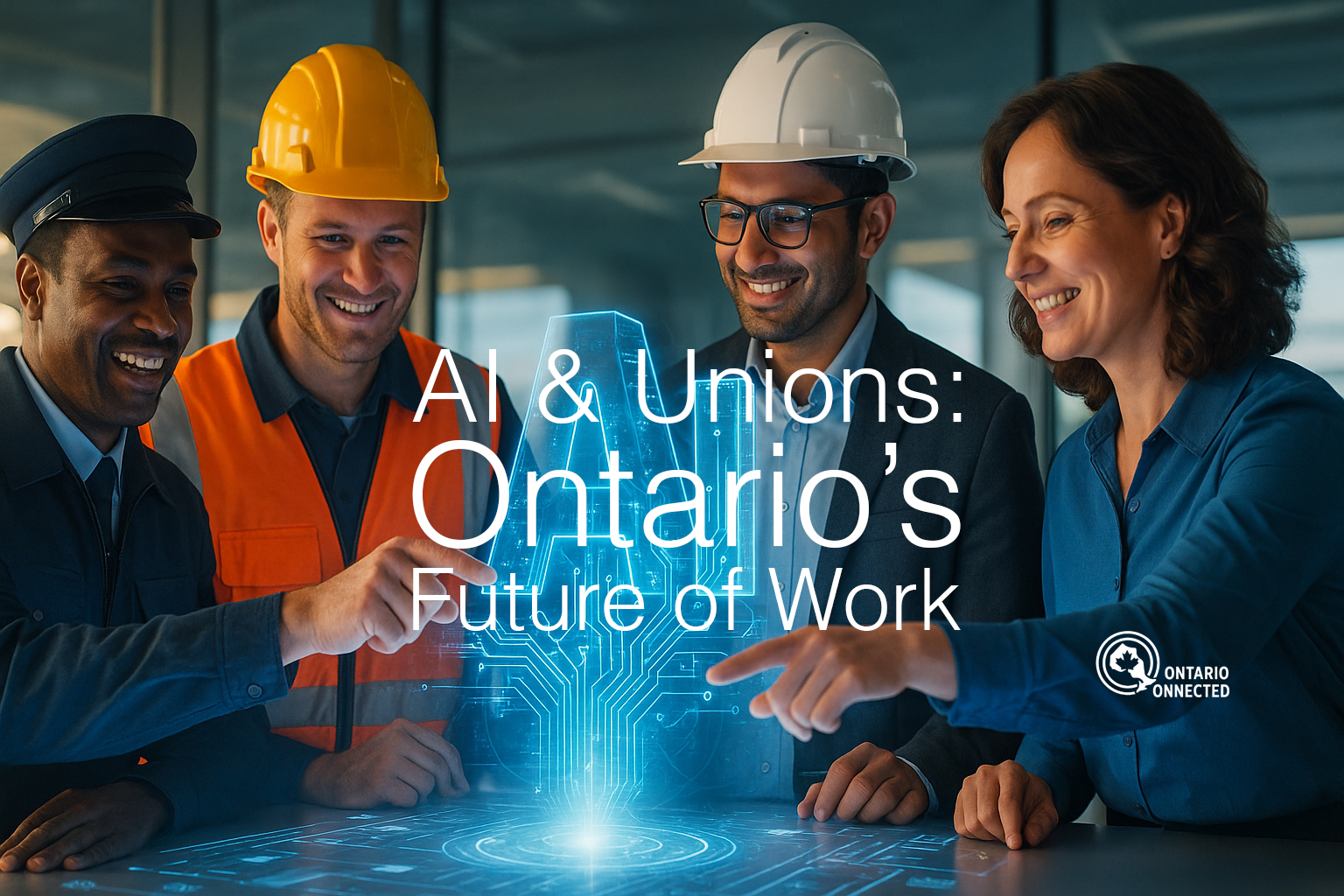
AI and unions are now central to Ontario’s future. Artificial intelligence is moving into workplaces rapidly, and many workers feel pressured to fear it. Ontario Connected takes a different view: modernization only succeeds when people stay in control. Technology may evolve, but people remain the centre of every system. This means AI and unions must shape how automation is used—before employers decide for them.
Table of Contents
- What AI and Unions Need to Understand About Modern Technology
- AI, Unions, and Ontario Connected’s Vision
- How AI and Unions Create a Stronger Ontario
- Why AI and Unions Must Lead the Transition—Not React to It
- How AI and Unions Can Build Confidence Instead of Fear
- AI and Unions Will Shape Ontario’s Labour Future
For decades, workers have heard warnings that machines would replace them. The same fear appeared with factory automation, early computers, and scheduling software. Each time, the truth became clear: jobs changed, workers adapted, and unions defended their members. The real risk only emerges when workers are excluded from decisions.
AI follows the same pattern. It is not a supervisor, not a replacement, and not a threat by default. Instead, it is a tool—fast, powerful, and sometimes disruptive. When employers introduce AI without transparency or oversight, that is when it becomes dangerous. Because of that reality, AI and unions must move forward together.
What AI and Unions Need to Understand About Modern Technology
AI recognizes patterns, analyzes data, drafts text, predicts outcomes, and automates repetitive work. However, it cannot understand context. It cannot take responsibility. It cannot handle unpredictable real-world conditions the way trained workers can. Ontario’s transit systems, utilities, construction projects, and public services all rely on human judgment.
AI cannot replace the qualities that make workers essential:
- Immediate real-world decision-making
- Responsibility and liability
- Situational awareness in fast-changing environments
- Human communication and problem-solving
- Ethical reasoning grounded in lived experience
Workers remain the foundation of safety and public service. AI may support them, but workers make the final call. Therefore, AI and unions must build a clear, informed partnership instead of reacting through fear.

Workers leading Ontario’s modernization through safe, confident, human-guided AI systems.
AI, Unions, and Ontario Connected’s Vision
Ontario Connected focuses on long-term planning—stronger infrastructure, reliable transit, efficient services, and a resilient workforce. These goals appear throughout Ontario’s long-term planning phases, where each stage depends on skilled workers, not just software or hardware. Because of this, modernization cannot succeed unless people guide it. AI becomes useful only when workers and unions direct how it is used.
Transportation, utilities, construction, public service, logistics, and healthcare will all experience AI-driven changes. Most of these industries rely on unionized labour. If unions do not lead the transition, employers will introduce technology without protections—and that is when jobs become vulnerable.
Ontario Connected has already identified significant roadblocks to modernization, including political hesitation and outdated infrastructure. However, a new risk has emerged: the rollout of unregulated workplace AI. When AI and unions work together, this roadblock disappears and workers become stronger, not weaker.
How AI and Unions Create a Stronger Ontario
When AI and unions work in the same direction, Ontario gains a powerful advantage. AI handles predictable tasks, large data sets, and repetitive work. Meanwhile, workers focus on safety, service, judgment, and the human responsibilities that AI cannot manage. As a result, the province benefits from safer systems and better services.
AI and unions working together build modernization that protects workers instead of replacing them. This approach enables Ontario to upgrade its systems without sacrificing job quality or fairness. It transforms AI from a threat into a powerful tool for workers and communities.
Why AI and Unions Must Lead the Transition—Not React to It
If unions wait, employers will introduce AI systems without transparency. These tools already appear in scheduling, monitoring, maintenance prediction, and incident flagging. When these systems roll out quietly, job security weakens. Therefore, strong contract language and early involvement must come first.
Frontline experience shows why this matters. Stories shared in The Operator’s Window highlight the pressure, unpredictability, and safety decisions workers handle every day. No algorithm understands those moments the way trained people do. That reality must stay protected as AI tools enter the workplace.
To secure the future, unions need clear requirements built directly into their collective agreements:
1. Worker-in-the-Loop Mandates
- mandatory human oversight for any AI-supported action
- worker approval for all safety-critical steps
- limits on fully automated systems with no human review
2. Mandatory Training and Upskilling
- fully paid by employers
- completed during work hours
- accessible to every affected member
- updated regularly as technology evolves
This ensures AI and unions strengthen workers instead of dividing them by skill level. When every member is trained, the entire bargaining unit becomes harder to replace or undermine.
3. Full Transparency and Data Disclosure
- which AI tools are being introduced and why
- what decisions or tasks the AI influences
- how data is collected and used
- whether AI affects evaluations, scheduling, or discipline
This expectation aligns with national standards. According to the Government of Canada’s labour and workforce policies, modernization must include transparency, oversight, and human rights protections. International frameworks such as the OECD AI Policy Guidelines emphasize accountability and human control.
4. Protection From Algorithmic Discipline
- mandatory human investigation for any AI-based allegation
- a right to challenge and question automated evidence
- clear bans on discipline triggered only by software
5. Job Evolution, Not Job Elimination
- jobs must remain unionized, even when duties shift
- task changes instead of job cuts
- support as workers transition into new responsibilities
This approach reflects Ontario Connected’s worker-first vision: modernization should strengthen job quality, not weaken it.
How AI and Unions Can Build Confidence Instead of Fear
Fear weakens worker power, and employers often benefit from it. However, Ontario Connected promotes the opposite: a confident workforce guiding modernization. When workers feel in control, they embrace new tools instead of resisting them.
Above all, workers need clarity. Specifically, they should know that:
- AI supports their skills instead of replacing them
- safe operation always requires human oversight
- technology increases the value of skilled labour
- training provides protection and confidence
In addition, unions must communicate confidently: AI is your tool, not your replacement. This message aligns with responsible national policy. According to the federal government’s responsible AI guidelines, modernization must remain transparent, accountable, and centred on human oversight. These same principles belong inside every workplace.
When AI and unions work together, members see leadership instead of uncertainty. As a result, fear fades and long-term stability improves. Workers accept AI tools more easily when they trust the protections negotiated on their behalf.
AI and Unions Will Shape Ontario’s Labour Future
Looking ahead, AI will influence Ontario’s next 50 years across every major sector. However, AI alone cannot lead modernization. Workers and unions must guide the province forward. They bring judgment, experience, and responsibility—qualities no algorithm can copy.
This idea sits at the centre of Ontario Connected’s long-term vision: modernization must support people, not replace them. When unions shape how AI enters workplaces, Ontario gains safer systems, better services, and stronger jobs.
AI and unions working together will determine whether Ontario becomes a province where innovation empowers workers—or a province where modernization weakens them. The future depends on which people guide the technology.
For more information on responsible AI and workforce policy, visit the Government of Canada’s workforce modernization resources.
The future of Ontario is not AI replacing people. The future is people guiding AI—with unions leading the way.






Leave A Comment
You must be logged in to post a comment.