
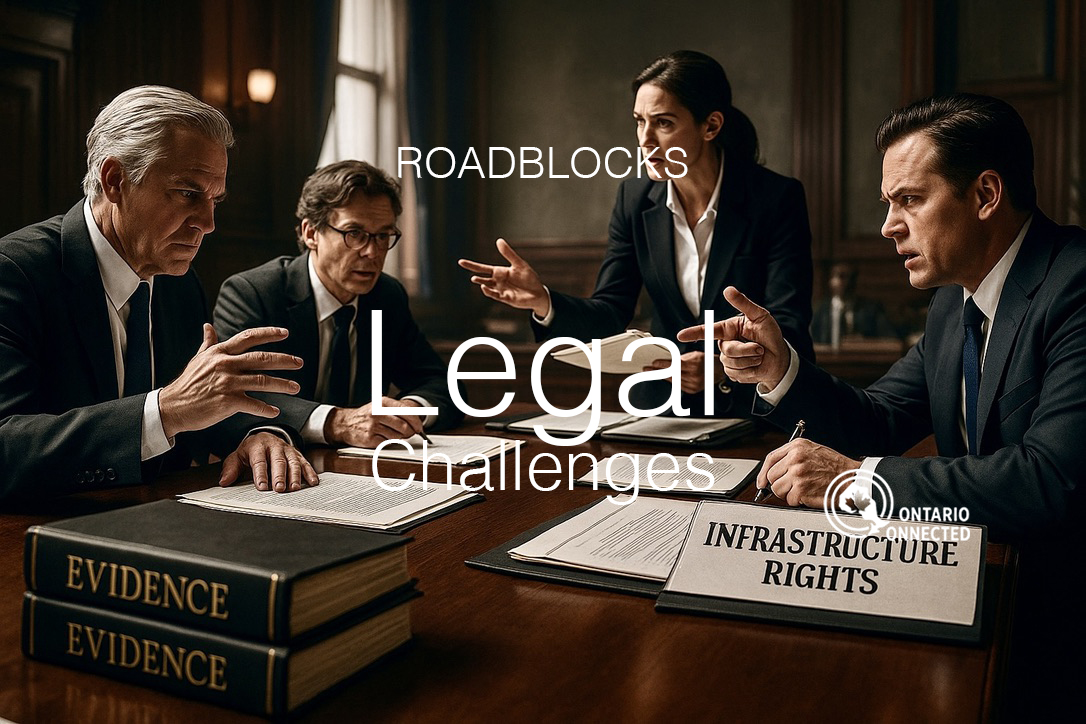
Legal Challenges: When Courtrooms Slow Down Ontario’s Future
Legal challenges can stop a major Ontario project faster than any budget problem or construction delay. A single lawsuit, injunction, or appeal can freeze progress for months or even years. While lawyers argue, communities wait. As a result, timelines collapse, costs rise, and frustration spreads across the province.
Imagine a new transit line designed to shorten a brutal commute in Brampton. The route is ready, the funding is confirmed, and the public wants relief. However, one legal challenge from a property group can halt everything. The community waits while both sides prepare documents, request extensions, and argue procedural details. The process feels endless.
Legal challenges affect many projects in Ontario. For example, environmental appeals delay transit lines. Landowner disputes stall road expansions. Contract disagreements slow hospital upgrades. These disruptions often connect to other roadblocks like funding uncertainty and bureaucracy, making delays even worse.
Why Legal Challenges Stall Ontario Projects
Most large projects touch multiple laws. As a result, almost any decision can be appealed. Although appeals exist to protect the public, they often become tools to delay or block important work. A small group can slow progress for thousands of people.
- Environmental appeals: Opponents argue the assessments are incomplete or outdated.
- Land ownership disputes: Property lines, easements, and access rights trigger legal battles.
- Contract disagreements: Contractors and governments fight over scope, deadlines, or costs.
- Indigenous consultation concerns: When governments skip steps, courts intervene.
These legal challenges don’t always block projects forever. Instead, they slow them down to the point where costs rise faster than funding can keep up. Infrastructure Ontario often highlights this risk in their reports (infrastructureontario.ca).
The Human Cost Behind Every Legal Delay
Every legal challenge creates consequences that people feel in their daily lives. A commuter must wait longer for a new transit line. A parent keeps hearing that a long-promised school is “still under review.” A senior remains stuck on a hallway bed because a hospital expansion is tied up in court.
These delays feel invisible because they happen in courtrooms and meeting rooms. However, the impact hits real people every day. Meanwhile, construction teams lose momentum. Costs increase. Progress fades.
The Ripple Effect of Legal Action
When a project faces legal challenges, everything around it becomes unstable. The delays create uncertainty. Contractors hesitate. Municipal partners reconsider their plans. Therefore, budgets fall apart as inflation increases.
- Cost escalation: Each delay adds millions in inflation and redesigns.
- Loss of skilled workers: Crews move to other projects while the dispute drags on.
- Reduced public trust: Communities stop believing new timelines.
- Wasted planning money: Studies, designs, and consultations expire.
Legal challenges also weaken public support. Residents see repeated delays and assume the project is flawed, even when the issue is procedural rather than structural.
Solving Legal Challenges Before They Start
The best way to reduce legal challenges is to prevent them. Clear communication, early consultation, and transparent decision-making lower the risk of disputes. When governments move too fast or hide information, lawsuits rise.
- Stronger early consultation: Partner with communities and Indigenous groups at the beginning.
- Clearer documentation: Avoid gaps that opponents use to challenge approvals.
- Accurate project scoping: Reduce contract disputes through realistic planning.
- Transparent decision timelines: Show the public how choices are made.
According to the Canadian Environmental Assessment Agency (canada.ca), many appeals happen when governments rush assessments or skip important steps. Better preparation lowers the risk.
Legal Tools Should Protect Us—Not Paralyze Us
Ontario needs legal protections. People must have the right to challenge decisions that harm communities, land, or the environment. However, the system must also prevent a small group from using legal challenges to block vital public services. The balance between protection and progress is broken.
Legal challenges will always happen. The question is whether Ontario’s system can handle them without collapsing timelines or destroying budgets. Until that balance improves, courtrooms will continue to slow projects long before shovels hit the ground.


Leave A Comment
You must be logged in to post a comment.