
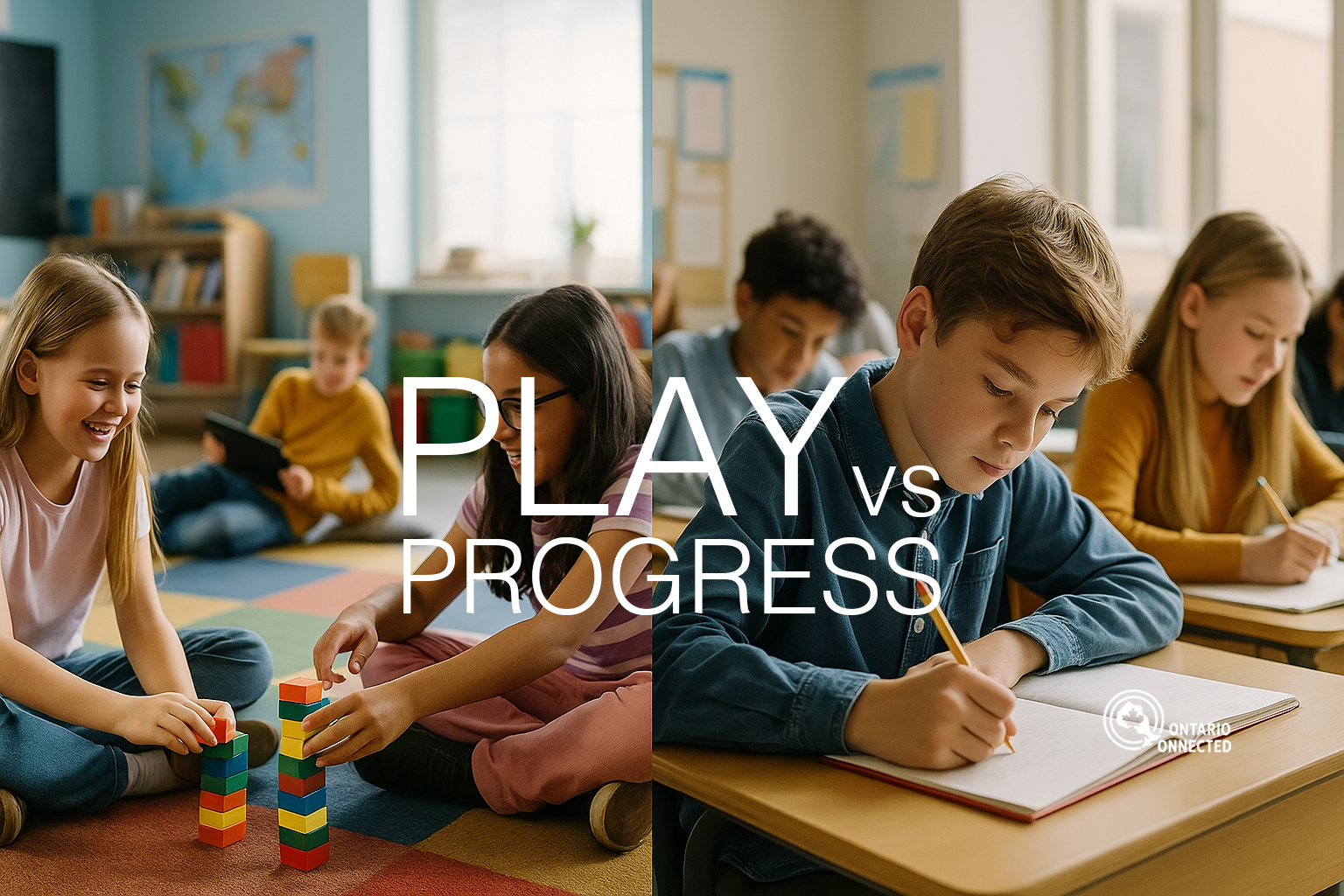
Play vs. Progress in Ontario Education: When Childhood Comfort Comes at the Cost of Learning
Editor’s Note: OntarioConnected publishes evidence-informed analysis on education, infrastructure, and long-term provincial resilience. Articles in this series distinguish between verifiable data, reasoned inference, and values-based conclusions.
Ontario rightly values childhood creativity, curiosity, and emotional well-being. However, the growing emphasis on Play vs. Progress in Ontario education has shifted classrooms increasingly toward comfort, ease, and entertainment. When learning is expected to feel effortless, discipline weakens, expectations soften, and measurable academic progress declines.
As a parent educated in a system that emphasized rigour, repetition, and high expectations, the pattern is difficult to ignore. Ontario has blurred the line between protecting children and underpreparing them. Learning environments are often designed to minimize discomfort rather than to build capability. While well intentioned, this shift risks depriving students of the skills required for long-term success.
Related analysis: These trends align closely with declining assessment outcomes discussed in our review of EQAO results and what they reveal about Ontario’s education system.
What “Play vs. Progress” Means in Ontario Classrooms
Play has always been an essential component of childhood development. When used appropriately, it supports curiosity, exploration, and engagement. In recent years, however, play-based learning in Ontario has increasingly shifted from a pedagogical tool to a guiding philosophy—sometimes replacing structured academic challenge rather than complementing it.
The underlying assumption is that learning should feel natural and stress-free. Yet meaningful learning has never been effortless. Whether in mathematics, reading, writing, or science, progress requires repetition, correction, focus, and sustained effort.
A system that consistently avoids difficulty sends an implicit message: if learning feels hard, expectations should be lowered. This mindset sits at the center of the Play vs. Progress Ontario education debate.
How the Play vs. Progress Culture Undermines Skill Development
In an effort to reduce discomfort, academic expectations across many Ontario classrooms have gradually softened:
- Challenging assignments are replaced with creative alternatives.
- Deadlines become flexible or optional.
- Assessment practices are adjusted to protect confidence.
- Critical feedback is minimized or delayed.
- Academic pressure is framed as harmful rather than developmental.
These choices are often motivated by compassion. However, they carry unintended consequences. When learning experiences are designed to avoid struggle, students fail to develop resilience, stamina, and problem-solving capacity. Productive struggle—the mechanism through which understanding deepens—is reduced or removed.
Education systems that maintain consistent expectations tend to produce stronger foundational skills. Many immigrant families arrive in Canada shaped by such systems, and the difference is often visible in academic preparedness and learning habits.
Why Children Need Challenge in the Play vs. Progress Debate
Play contributes to joy and engagement, but challenge builds capability. A balanced education system requires both. Ontario’s current trajectory increasingly treats challenge as something to be avoided rather than managed constructively.
Students are frequently encouraged with messages such as:
- “Do what feels comfortable.”
- “It’s okay if you don’t understand right now.”
- “You’ll get there eventually.”
Equally important messages are often missing:
- “This will be difficult, and that is normal.”
- “Improvement requires practice and correction.”
- “Progress depends on effort, not encouragement alone.”
The Play vs. Progress Ontario education discussion is not about removing joy from learning. It is about restoring the expectation that effort and persistence are essential to growth.
The Academic Cost of Too Much Play and Not Enough Progress
Play-based learning is most effective when paired with structure, discipline, and accountability. Without these anchors, academic outcomes deteriorate and attention spans weaken.
Increasingly common classroom patterns include:
- Reduced focus and task persistence
- Resistance to structured assignments
- Dependence on entertainment-driven instruction
- Lower numeracy and literacy outcomes
- Discomfort with correction or feedback
- Declining academic stamina
These are systemic effects, not individual failings. They reflect an education culture that has tilted too far toward the “play” side of the Play vs. Progress equation.
Why Ontario Must Rebalance Play vs. Progress
This is not a call to eliminate play from classrooms. It is a call to restore balance. Children need creativity and emotional support, but they also require rigour, discipline, and perseverance.
1. Reinstate Academic Rigour
Mastery requires challenge, repetition, and correction. Avoiding difficulty undermines learning outcomes.
2. Establish Clear and Consistent Expectations
Advancement should reflect demonstrated proficiency, not participation alone.
3. Teach the Value of Sustained Effort
Effort is the engine of progress. Students must learn that improvement is earned through practice.
4. Reduce Reliance on Entertainment-Based Learning
Engagement matters, but not every lesson needs to be entertaining. Some lessons need to be mastered.
5. Restore Discipline as a Constructive Educational Tool
Discipline provides structure, consistency, and focus—conditions necessary for long-term success.
Play vs. Progress and the Future of Ontario Students
Childhood joy is important. However, joy without competence is fragile. Ontario risks raising students who feel supported yet lack the resilience, skills, and discipline required to thrive in adulthood.
Play vs. Progress in Ontario education is not an argument against creativity or emotional development. It is a call to restore seriousness to learning. Children deserve joyful childhoods, but they also deserve futures defined by opportunity—and opportunity grows from capability.
Ontario faces a choice: continue lowering expectations to preserve comfort, or rebalance education to prepare students for real-world demands. That choice begins with what we teach—and what we expect.
Methodology & Scope
This analysis draws on OECD education research, comparative pedagogy literature, Ontario curriculum frameworks, and cross-system observations. Where direct causality cannot be empirically proven, conclusions are presented as reasoned inferences.
Sources & Further Reading
- OECD Education Directorate
- OECD PISA Assessments
- Ontario Curriculum Documents
- Higher Education Quality Council of Ontario





Leave A Comment
You must be logged in to post a comment.