
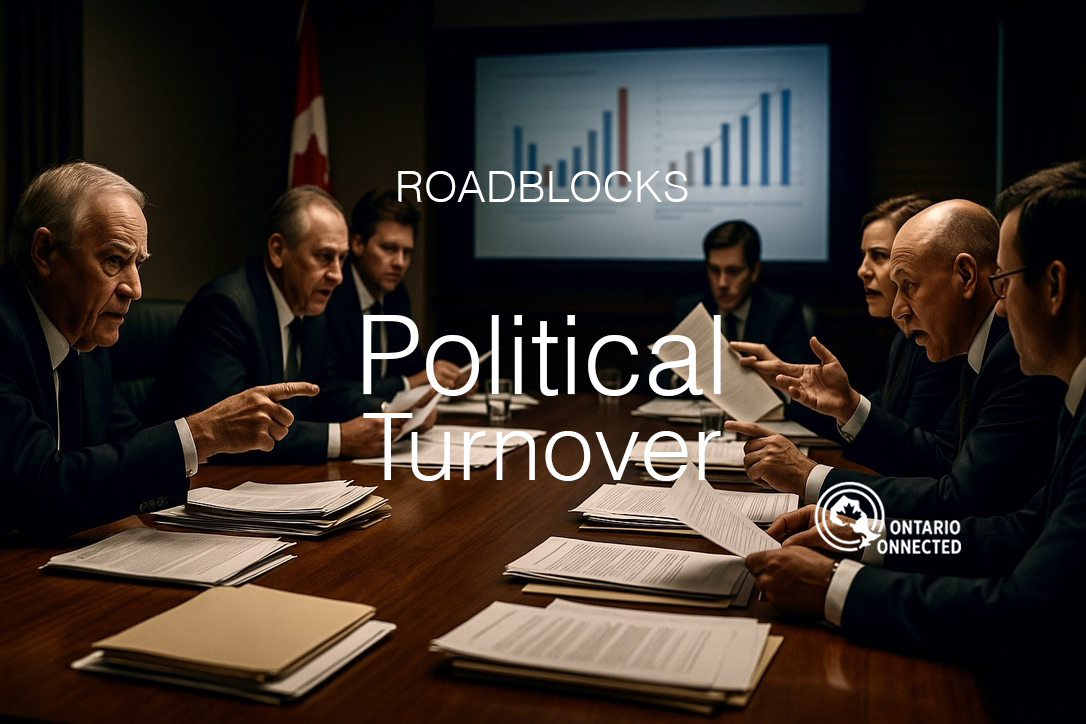
Political Turnover in Ontario: Elections as Reset Buttons
Every four years, Ontario goes through a familiar ritual: campaign signs, debates, promises, and hope. But for infrastructure, political turnover in Ontario does more than change leaders—it resets decades-long projects as if they were short-term ideas. For commuters, patients, and families, it feels like the ground keeps shifting while the future they were promised keeps slipping away.
On the subway platform at Kennedy Station, a commuter remembers the day the Ontario Line was announced. She pictured a future where she’d get home early enough to read her kids a bedtime story. Years later, she’s still hearing new completion dates. With every new government, the project gets revised, rescoped, or re-evaluated. What she really wants is simple: something built within her lifetime.
How Political Turnover in Ontario Derails Progress
Political turnover isn’t just a change of faces. It disrupts timelines, resets priorities, and forces major projects to start over—again and again.
- Shifting scopes. A transit extension is designed under one government. The next wants a different alignment. Years of planning are erased in a day. The public sees only more waiting.
- Funding pauses. A hospital expansion approved and celebrated suddenly goes “under review” after an election. Construction stalls. Overcrowded hallways remain full.
- Promises without continuity. Housing targets are set, then replaced. Programs are launched, then cancelled. Families waiting for affordable homes are caught in the political crossfire.
We’ve seen the consequences firsthand. The Ontario Line, once costed at $10.9 billion, has ballooned to more than $27 billion, with completion pushed to 2031. Inflation plays a part, yes—but so does the stop-and-go effect of political resets. The Eglinton Crosstown? A decade of disputes, redesigns, and shifting priorities. It is the clearest symbol of what happens when infrastructure becomes political currency.
The Human Cost of Political Reset Cycles
Every political reset creates real-world consequences for real people.
- A nurse in Mississauga works another overtime shift because her hospital expansion was paused “for review.” She wonders if she’ll ever see the new wing completed.
- A renter in Hamilton, saving every dollar for a future home, watches another affordable housing plan get rewritten after an election. Each delay pushes her dream further out of reach.
- A family in Whitby sits in endless traffic while listening to yet another news update on a transit line that keeps changing direction—literally and politically.
These aren’t abstract delays. They are hours lost, dollars wasted, and hopes postponed. Political turnover isn’t just a governance issue. It’s a life issue.
Solutions That Break the Cycle
Ontario doesn’t need to choose between democracy and long-term planning. It can have both—if we change the rules around how mega-projects survive political cycles.
- Legislated multi-year funding. Guarantee funding across full project phases, not year-to-year budgets that reset with every election.
- Cross-party infrastructure compacts. Transit, housing, and hospitals should not be partisan battlegrounds. Commitments should survive election cycles, not depend on them.
- Independent reporting. A public, third-party oversight body can publish real timelines and real costs—reducing political spin and forcing accountability.
- Protected project scopes. Once a design is approved and procurement is underway, it should not be rewritten because a new minister prefers a different map.
Building What Ontarians Deserve
People in this province are not unreasonable. They understand governments change. What they don’t accept is that essential projects restart every time someone new sits in a chair at Queen’s Park. They want transit that arrives before their kids graduate, hospitals that don’t overflow into hallways, and housing that’s built faster than policies are rewritten.
To build a better Ontario, we must stop treating elections like demolition buttons. A new government shouldn’t erase years of planning—it should inherit responsibility for continuing it. Only then will Ontarians trust that when something is announced, it will truly be delivered.
Explore Related Roadblocks
- Roadblocks: Bureaucracy
- Roadblocks: Funding Uncertainty
- Roadblocks: Environmental Assessments
- Roadblocks Series Hub
For public data on project oversight, see Ontario’s Auditor General: auditor.on.ca.



Leave A Comment
You must be logged in to post a comment.