
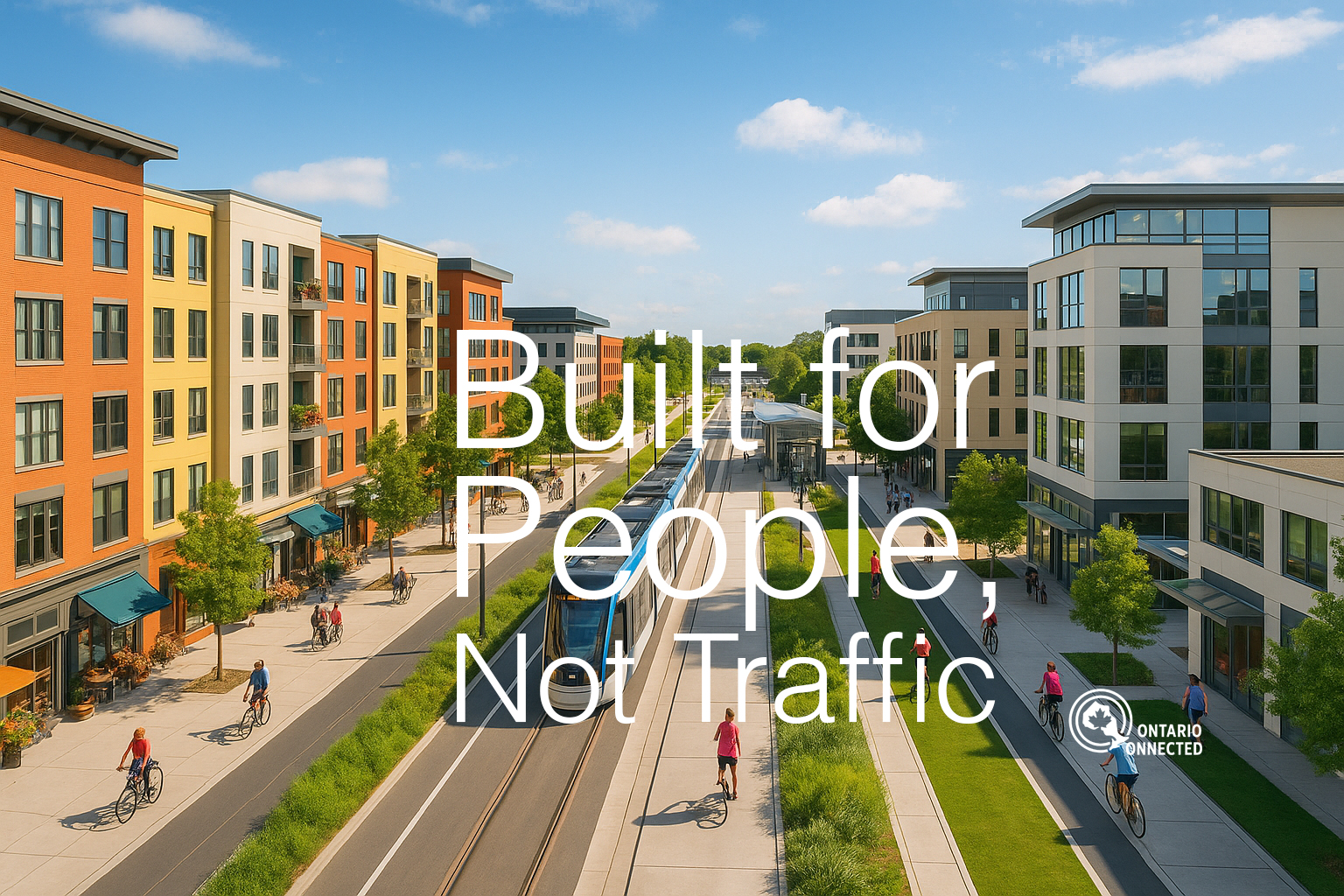
Work-live communities in Ontario are quickly becoming the necessary evolution of how our cities and suburbs function. For decades, Ontario was built on the assumption that people would live in one place, work in another, and rely on a highway to connect the two. That model delivered space and opportunity, but it also locked millions into long commutes, fragmented services, and neighbourhoods that only work if you own a car.
Today, that model is at its limits. Population growth, housing scarcity, climate pressures, and changing work patterns are all converging. The question is no longer whether the system needs to change, but what comes next. Increasingly, the answer is clear: the next chapter will be defined by work-live communities in Ontario—districts where housing, employment, services, and infrastructure are designed to work as one system instead of pulling in opposite directions.
The End of the Classic Suburban Bargain in Work-Live Communities in Ontario
The classic post-war suburb in Ontario was built on three assumptions:
- Land on the urban fringe would always be cheap and plentiful.
- Highways could continually expand to absorb rising traffic volumes.
- Employment would remain concentrated in major downtowns or industrial zones.
Those assumptions no longer hold. Land near major urban centres is expensive. Highway widening delivers temporary relief before congestion returns. Employment has become more distributed—with office parks, hospitals, schools, and logistics hubs spread across the region.
The “more distance for more space” bargain has also collapsed. Households spend more time and money shuttling between disconnected land uses: work in one direction, childcare in another, groceries a few kilometres away, and recreational spaces somewhere else entirely. The daily circuit is exhausting—and it’s a product of the landscape itself.
In this context, work-live communities in Ontario are not a lifestyle trend; they are the structural response to a model that has reached its limits.
The Economic Limits of Sprawl and How Work-Live Communities in Ontario Address Them
Sprawling development patterns do not just cost time—they strain municipal budgets. Every new road, sewer, pipe, and transit route must be maintained, plowed, patrolled, cleaned, and eventually replaced. When development spreads outward in low-density patterns, the tax revenue per kilometre of infrastructure is too low to support long-term costs.
Municipalities face a difficult equation:
- More spread-out development = more infrastructure per household.
- More infrastructure per household = higher future maintenance costs.
- Higher costs without matching revenue = structural financial pressure.
Shifting toward work-live communities in Ontario—with more people and jobs sharing the same serviced land—is one of the only ways to make the math sustainable without major tax increases or service reductions.
Why Work-Live Communities in Ontario Are Becoming Inevitable
Multiple forces are pulling Ontario away from single-use suburbs and toward integrated communities:
Hybrid and Remote Work
Not everyone can work from home, but hybrid patterns are widely established. Even two remote days per week change commuting demand, commercial real estate patterns, and where people choose to live. Neighbourhoods that offer local workspaces, co-working hubs, and essential services are inherently more resilient.
Housing Pressures
Ontario’s housing crisis is about more than unit counts—it is about placement and connectivity. Building more subdivisions in remote areas without jobs, transit, or services just recreates the same accessibility problems. Work-live communities in Ontario align housing supply with daily needs.
Climate and Emissions
Transportation is one of the province’s largest sources of emissions. Long, car-dependent commutes are hardwired into the suburban model. By contrast, work-live districts reduce trip lengths, support transit, and make active mobility viable, offering emissions reductions without demanding extreme lifestyle changes.
Regional Growth Hubs and the Expansion of Work-Live Communities in Ontario
Ontario’s next era will not be shaped by a single mega-region but by a network of strong regional hubs. Cities like Barrie, Kitchener–Waterloo, London, Hamilton, Niagara, Oshawa, and Kingston are positioned to evolve into complete ecosystems rather than permanent Toronto satellites.
In a coordinated provincial strategy, work-live communities in Ontario can be developed around:
- Transit corridors linking hubs efficiently, reducing dependence on Toronto-centric networks.
- Mixed-use centres that combine jobs, housing, and services around major stations.
- Local anchors such as universities, health networks, logistics hubs, and clean-tech corridors.
This vision aligns with long-term, phased regional planning frameworks similar to those outlined in the Phases series on Ontario Connected, where growth is structured intentionally rather than reactively.
Designing Daily Life Within Work-Live Communities in Ontario

A cheerful, walkable neighbourhood where families can shop locally without cars.
The success of work-live communities in Ontario will ultimately be measured not by architectural renderings but by everyday lived experience. The goal is simple: make daily life easier, not harder.
Shorter, Smarter Trips
Essential needs become accessible through short, predictable trips:
- Groceries within walking distance or a short transit ride.
- Schools and childcare embedded inside the neighbourhood.
- Healthcare, pharmacies, and community centres nearby.
- Local workspaces that reduce full-time dependence on highways.
Streets for People
Human-scaled street design—protected bike lanes, safe crosswalks, narrower lanes, calming intersections—directly improves mobility and safety. Cars remain part of the landscape, but no longer dominate every design choice.
Public Spaces That Build Community
Parks, plazas, waterfront access, libraries, and cultural spaces create reasons for people to be out in public. These spaces support social ties, local businesses, and healthy neighbourhood rhythms.
Infrastructure and Transit Supporting Work-Live Communities in Ontario
None of this is possible without infrastructure that supports mixed-use, compact districts. Work-live communities in Ontario rely on three foundational pillars:
1. Physical Infrastructure
Water, energy, sewers, and utilities must be planned with intensification in mind. Compact development reduces per-capita costs and increases long-term efficiency.
2. Transit and Active Mobility
Transit must function as a backbone—not an afterthought. Frequent, reliable service along defined corridors connects hubs and reduces mandatory car trips. Where high-order transit is not yet viable, strong bus networks and protected cycling routes still provide predictable mobility.
3. Digital Connectivity
Fast, reliable digital infrastructure enables remote work, online services, local entrepreneurship, telehealth, and education. Fibre and 5G are not luxuries—they are foundational utilities.
For additional research on mixed-use models in Canada, the Canadian Urban Institute provides detailed case studies: Canadian Urban Institute.
Policy Shifts Needed to Build Work-Live Communities in Ontario
Many barriers to work-live communities in Ontario are policy-based rather than technical. Ontario will need to shift toward:
- Zoning reform allowing mixed-use, multi-functional districts.
- Revised parking minimums to free land for housing or public spaces.
- Long-term funding models aligned with multi-decade strategies instead of short political cycles.
- Regional coordination so municipalities reinforce shared corridors, hubs, and employment clusters instead of competing with each other.
This approach mirrors the challenges outlined in the Roadblocks series on Ontario Connected, where systemic obstacles are identified and addressed across several phases.
What Comes After the Suburb: The Rise of Work-Live Communities in Ontario
Ontario will not demolish its suburbs—but it can evolve them. Retrofitting neighbourhoods with mixed-use nodes, local employment, transit improvements, and community spaces is more sustainable than decades of outward expansion.
The future is not anti-suburb—it is post-commute. The goal is a province where people are not forced into multi-hour migrations just to meet basic daily needs. Work-live communities in Ontario offer a better alternative: neighbourhoods close to opportunity, supported by modern infrastructure, and built around people instead of traffic patterns.
If Ontario chooses this path—with clear phasing, honest constraint analysis, and a 30–50 year horizon—the province can move from reactive growth to strategic development. The future is already taking shape. The question now is whether we build it by design or by default.
The Future of Work-Live Communities in Ontario: What Comes After the Suburb?
Work-live communities in Ontario are quickly becoming the necessary evolution of how our cities and suburbs function. For decades, Ontario was built on the assumption that people would live in one place, work in another, and rely on a highway to connect the two. That model delivered space and opportunity, but it also locked millions into long commutes, fragmented services, and neighbourhoods that only work if you own a car.
Today, that model is at its limits. Population growth, housing scarcity, climate pressures, and changing work patterns are all converging. The question is no longer whether the system needs to change, but what comes next. Increasingly, the answer is clear: the next chapter will be defined by work-live communities in Ontario—districts where housing, employment, services, and infrastructure are designed to work as one system instead of pulling in opposite directions.
The End of the Classic Suburban Bargain in Work-Live Communities in Ontario
The classic post-war suburb in Ontario was built on three assumptions:
- Land on the urban fringe would always be cheap and plentiful.
- Highways could continually expand to absorb rising traffic volumes.
- Employment would remain concentrated in major downtowns or industrial zones.
Those assumptions no longer hold. Land near major urban centres is expensive. Highway widening delivers temporary relief before congestion returns. Employment has become more distributed—with office parks, hospitals, schools, and logistics hubs spread across the region.
The “more distance for more space” bargain has also collapsed. Households spend more time and money shuttling between disconnected land uses: work in one direction, childcare in another, groceries a few kilometres away, and recreational spaces somewhere else entirely. The daily circuit is exhausting—and it’s a product of the landscape itself.
In this context, work-live communities in Ontario are not a lifestyle trend; they are the structural response to a model that has reached its limits.
The Economic Limits of Sprawl and How Work-Live Communities in Ontario Address Them
Sprawling development patterns do not just cost time—they strain municipal budgets. Every new road, sewer, pipe, and transit route must be maintained, plowed, patrolled, cleaned, and eventually replaced. When development spreads outward in low-density patterns, the tax revenue per kilometre of infrastructure is too low to support long-term costs.
Municipalities face a difficult equation:
- More spread-out development = more infrastructure per household.
- More infrastructure per household = higher future maintenance costs.
- Higher costs without matching revenue = structural financial pressure.
Shifting toward work-live communities in Ontario—with more people and jobs sharing the same serviced land—is one of the only ways to make the math sustainable without major tax increases or service reductions.
Why Work-Live Communities in Ontario Are Becoming Inevitable
Multiple forces are pulling Ontario away from single-use suburbs and toward integrated work-live communities in Ontario:
Hybrid and Remote Work in Work-Live Communities in Ontario
Not everyone can work from home, but hybrid patterns are widely established. Even two remote days per week change commuting demand, commercial real estate patterns, and where people choose to live. Neighbourhoods that offer local workspaces, co-working hubs, and essential services inside work-live communities in Ontario are inherently more resilient.
Housing Pressures in Work-Live Communities in Ontario
Ontario’s housing crisis is about more than unit counts—it is about placement and connectivity. Building more subdivisions in remote areas without jobs, transit, or services just recreates the same accessibility problems. Work-live communities in Ontario align housing supply with daily needs so that people are closer to opportunity.
Climate and Emissions in Work-Live Communities in Ontario
Transportation is one of the province’s largest sources of emissions. Long, car-dependent commutes are hardwired into the suburban model. By contrast, work-live communities in Ontario reduce trip lengths, support transit, and make active mobility viable, offering emissions reductions without demanding extreme lifestyle changes.
Regional Growth Hubs and the Expansion of Work-Live Communities in Ontario
Ontario’s next era will not be shaped by a single mega-region but by a network of strong regional hubs built around work-live communities in Ontario. Cities like Barrie, Kitchener–Waterloo, London, Hamilton, Niagara, Oshawa, and Kingston are positioned to evolve into complete ecosystems rather than permanent Toronto satellites.
In a coordinated provincial strategy, work-live communities in Ontario can be developed around:
- Transit corridors linking hubs efficiently, reducing dependence on Toronto-centric networks.
- Mixed-use centres that combine jobs, housing, and services around major stations.
- Local anchors such as universities, health networks, logistics hubs, and clean-tech corridors.
This vision aligns with long-term, phased regional planning frameworks similar to those outlined in the Phases series on Ontario Connected, where growth is structured intentionally rather than reactively.
Designing Daily Life Within Work-Live Communities in Ontario
The success of work-live communities in Ontario will ultimately be measured not by architectural renderings but by everyday lived experience. The goal is simple: make daily life easier, not harder.
Shorter, Smarter Trips in Work-Live Communities in Ontario
Inside work-live communities in Ontario, essential needs become accessible through short, predictable trips:
- Groceries within walking distance or a short transit ride.
- Schools and childcare embedded inside the neighbourhood.
- Healthcare, pharmacies, and community centres nearby.
- Local workspaces that reduce full-time dependence on highways.
Streets for People in Work-Live Communities in Ontario
Human-scaled street design—protected bike lanes, safe crosswalks, narrower lanes, calming intersections—directly improves mobility and safety in work-live communities in Ontario. Cars remain part of the landscape, but no longer dominate every design choice.
Public Spaces That Build Community in Work-Live Communities in Ontario
Parks, plazas, waterfront access, libraries, and cultural spaces inside work-live communities in Ontario create reasons for people to be out in public. These spaces support social ties, local businesses, and healthy neighbourhood rhythms.
Infrastructure and Transit Supporting Work-Live Communities in Ontario
None of this is possible without infrastructure that supports mixed-use, compact districts. Work-live communities in Ontario rely on three foundational pillars:
Physical Infrastructure in Work-Live Communities in Ontario
Water, energy, sewers, and utilities must be planned with intensification in mind. Compact development within work-live communities in Ontario reduces per-capita costs and increases long-term efficiency.
Transit and Active Mobility in Work-Live Communities in Ontario
Transit must function as a backbone—not an afterthought. Frequent, reliable service along defined corridors connects hubs and reduces mandatory car trips. Where high-order transit is not yet viable, strong bus networks and protected cycling routes still provide predictable mobility within work-live communities in Ontario.
Digital Connectivity in Work-Live Communities in Ontario
Fast, reliable digital infrastructure enables remote work, online services, local entrepreneurship, telehealth, and education. Fibre and 5G are foundational utilities for work-live communities in Ontario, not luxuries.
For additional research on mixed-use models in Canada that support work-live communities in Ontario, the Canadian Urban Institute provides detailed case studies: Canadian Urban Institute.
Policy Shifts Needed to Build Work-Live Communities in Ontario
Many barriers to work-live communities in Ontario are policy-based rather than technical. Ontario will need to shift toward:
- Zoning reform allowing mixed-use, multi-functional districts that enable genuine work-live communities in Ontario.
- Revised parking minimums to free land for housing or public spaces within work-live communities in Ontario.
- Long-term funding models aligned with multi-decade strategies instead of short political cycles, supporting stable investment in work-live communities in Ontario.
- Regional coordination so municipalities reinforce shared corridors, hubs, and employment clusters instead of competing, strengthening networks of work-live communities in Ontario.
This approach mirrors the challenges outlined in the Roadblocks series on Ontario Connected, where systemic obstacles are identified and addressed across several phases.
What Comes After the Suburb: The Rise of Work-Live Communities in Ontario
Ontario will not demolish its suburbs—but it can evolve them. Retrofitting neighbourhoods with mixed-use nodes, local employment, transit improvements, and community spaces is more sustainable than decades of outward expansion.
The future is not anti-suburb—it is post-commute. The goal is a province where people are not forced into multi-hour migrations just to meet basic daily needs. Work-live communities in Ontario offer a better alternative: neighbourhoods close to opportunity, supported by modern infrastructure, and built around people instead of traffic patterns.
If Ontario chooses this path—with clear phasing, honest constraint analysis, and a 30–50 year horizon—the province can move from reactive growth to strategic development. The future is already taking shape. The question now is whether we build it by design or by default—and work-live communities in Ontario are at the centre of that choice.





Leave A Comment
You must be logged in to post a comment.