
Ontario Bill 98 and transit workers: what you need to know
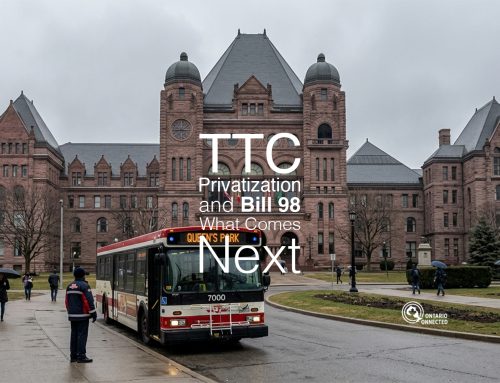
Ontario Bill 98, the Building Homes and Improving Transportation Infrastructure Act, 2026, was introduced by the Ford government on March 30, 2026. Most of the coverage focused on the housing and planning pieces. Understandable. But Schedule 4 of Ontario Bill 98, the Fare Alignment and Seamless Transit Act, 2026, is the part that every transit operator, dispatcher, and union rep in this province should be reading carefully.
I run trains on the YUS. I’ve been writing about Ontario transit for over a year. This one has my attention.
What Ontario Bill 98 actually does
Ontario Bill 98 has seven schedules covering housing density, planning rules, the Building Code, and transit. For workers and riders, Schedule 4 is the one that matters.
Under the Fare Alignment and Seamless Transit Act, the Minister of Transportation gets the authority to set fare prices, establish discount policies, set transfer rules, and require every prescribed transit system to join a unified provincial fare payment system. Stack that on top of the already-passed Getting Ontario Moving Act and the Building Transit Faster Act, and the province now controls virtually every decision shaping how transit is planned, priced, and delivered in Ontario.
The bill also extends the existing One Fare program into Hamilton and Halton Region. That’s where the trouble starts.
What Ontario Bill 98 gets right
I’m not going to pretend this legislation is all bad. The goal of regional fare integration is legitimate, and some of what Ontario Bill 98 proposes makes sense.
A single fare tap that moves someone from Mississauga through Toronto and into Hamilton without a penalty transfer is the right experience. It grows ridership. If ridership grows with proper funding behind it, that justifies expanded service and makes the case for more operators, not fewer.
The bill’s planning amendments also push for residential intensification around transit hubs. That’s been a consistent argument on this site: you can’t build a functioning transit network without also building density around the stations. The bill gets that part right.
The problem isn’t what the bill wants. The problem is how it goes about getting there, and what it leaves out entirely.
What Ontario Bill 98 gets wrong
On April 9, 2026, ATU Canada and all five GTHA transit locals wrote a joint letter to Minister of Transportation Prabmeet Sarkaria. The locals represent workers at the TTC, GO Transit and Metrolinx, MiWay, Brampton Transit, and the Hamilton Street Railway. It’s a serious document, written by people who understand the system.
Their framing is direct: “What the Province has proposed to date meets none of the conditions” required for integration that genuinely improves service.
Here’s what they mean.
Schedule 4 of Ontario Bill 98 gives the Minister unilateral authority to set fares, divide revenue between transit agencies, designate priority routes, and impose service standards across every transit system in Ontario. There are no enforceable protections for service levels, fare revenue, or worker rights. The minister gets the power. Nobody gets the accountability.
The contracting-out risk
At the TTC specifically, the ATU letter identifies 24 cross-boundary corridors covering 50 routes that could be handed to outside operators without service level agreements or accountability to Toronto City Council. The union’s words are exact: that “opens the door to contracting out work performed by ATU members for over a century.” Call it what it is. That’s not integration. That’s privatization wearing integration’s clothes.
One Fare is already draining 905 agencies
One Fare is pulling riders and revenue away from MiWay, Brampton Transit, and Hamilton Street Railway, with no provincial investment to fill the gap. Ontario Bill 98 accelerates that without addressing why it’s happening. At GO Transit, meanwhile, Local 1587’s members have watched Metrolinx expand its regional footprint while leaning more heavily on contracted services and temp agencies — exactly the erosion of the stable, unionized workforce that keeps a regional network functional.
The TTC-GO co-fare contradiction
The province cancelled the TTC-GO co-fare, a working regional fare integration tool, and then introduced Ontario Bill 98 and called it regional integration. The ATU letter handles this directly: “If the Province were serious about making transit work across the region, restoring the TTC-GO co-fare would be the clear and immediate first step.”
Workers don’t exist in this legislation
No provision in Ontario Bill 98 protects transit workers if fare revenue gets restructured or service delivery changes. Collective agreements, jurisdiction, labour standards: none of it gets a mention. As the ATU letter puts it, decisions affecting thousands of jobs are being made “without consulting the workers who do the work. That is not integration. It is fragmentation by design.”
The automation question nobody is asking
Ontario Bill 98 creates the structural preconditions for automation. A unified provincial platform means system-wide standardization, and standardization is historically what comes before decisions about automated dispatch, automated scheduling, and automated operations. The bill says nothing about any of that. But if authority over service design gets concentrated provincially with no worker protections, those conversations will happen without the union in the room. ATU locals shouldn’t be waiting for that discussion to start before they have a position.
What ATU is demanding
The April 9 letter has eight specific demands. Reading them together is the clearest way to understand what real integration would actually require.
The five locals want the province to stop further cross-boundary service changes until a genuine regional fare and operating funding framework is built, with real consultation involving transit agencies, municipalities, and unions.
They want the TTC-GO co-fare restored immediately, as a precondition for any further cross-boundary changes. No co-fare restoration, no further integration.
They want enforceable service level agreements on cross-boundary routes, with standards that match or exceed what the TTC currently provides, and real accountability to municipal officials and agencies on both sides of the boundary.
They want fare revenue transparency and protection. No municipality or agency in the 416 or 905 should lose operating revenue because of integration. Fare allocation models need to be public and agreed upon before anything changes.
They want a written provincial commitment that cross-boundary integration won’t result in contracting out to private operators. All GTHA transit service should continue to be delivered by public sector workers represented by their unions.
They want dedicated, stable provincial operating funding for all GTHA transit systems, so agencies aren’t forced to cut service, raise fares, or compete against each other to cover gaps the province created.
They want the province to fully fund the Hazel McCallion Line’s operating costs, so those costs don’t get downloaded onto Mississauga and strip resources from MiWay’s local routes.
Finally, they want formal consultation required before any cross-boundary service change gets implemented, with clear accountability for decisions within each jurisdiction.
Read that list, then read Ontario Bill 98. None of those protections are in it.
Why this matters beyond the GTHA
I’ve spent over a year writing about why Ontario needs to stop patching a transit system that was never built for the province we’ve become. More than forty articles. A 50-year infrastructure blueprint from Windsor to Ottawa, Niagara to Sudbury, every city where people are stuck in traffic that didn’t have to exist. The argument isn’t complicated: build it right, build it once, stop reorganizing the deck chairs.
Ontario Bill 98 is the test of whether the province is actually moving in that direction or just accumulating authority without the funding commitments to back it up. Based on what’s in the legislation right now, it looks more like the latter. We’ve seen this pattern before in fragmented municipal planning — when authority is centralized without shared standards and stable funding, the result is delay, inequity, and workers absorbing costs they didn’t create.
The National Observer reported in April 2026 that the Ford government wants control of transit fares province-wide. What that framing misses is the downstream effect on the workers who deliver those services every day.
The ATU locals put it plainly in their letter:
“Transit workers across this region are not opposed to integration that genuinely improves service for riders. We support a regional transit system that works for everyone. But integration must be built on a foundation of stable funding, enforceable service protections, transparent fare allocation, and respect for the workers who deliver the service. What the Province has proposed to date meets none of those conditions.”
Seamless transit is worth building. Not like this.
Quick reference: Ontario Bill 98 at a glance
| Full title | Building Homes and Improving Transportation Infrastructure Act, 2026 |
| Introduced | March 30, 2026 |
| Transit schedule | Schedule 4, Fare Alignment and Seamless Transit Act, 2026 |
| Minister’s new powers | Set fares, divide revenue, designate routes, impose service standards province-wide |
| One Fare extended to | Hamilton and Halton Region |
| TTC routes at risk | 24 cross-boundary corridors, 50 routes (per ATU letter, April 9, 2026) |
| Worker protections | None in the legislation |
| Service level minimums | None legislated |
| Consultation required | Not before ministerial regulation |
| ATU letter | April 9, 2026, signed by all 5 GTHA locals |
Ontario Connected is an independent research and advocacy platform. All articles are free to read, no paywall. The views here are my own analysis of public policy, intended to inform civic, labour, and government conversations about Ontario’s transit future.
Sources: Bill 98, Legislative Assembly of Ontario · ATU Canada joint letter to Minister Sarkaria, April 9, 2026 · National Observer, April 2, 2026 · Environmental Registry of Ontario · CP24



Leave A Comment
You must be logged in to post a comment.