
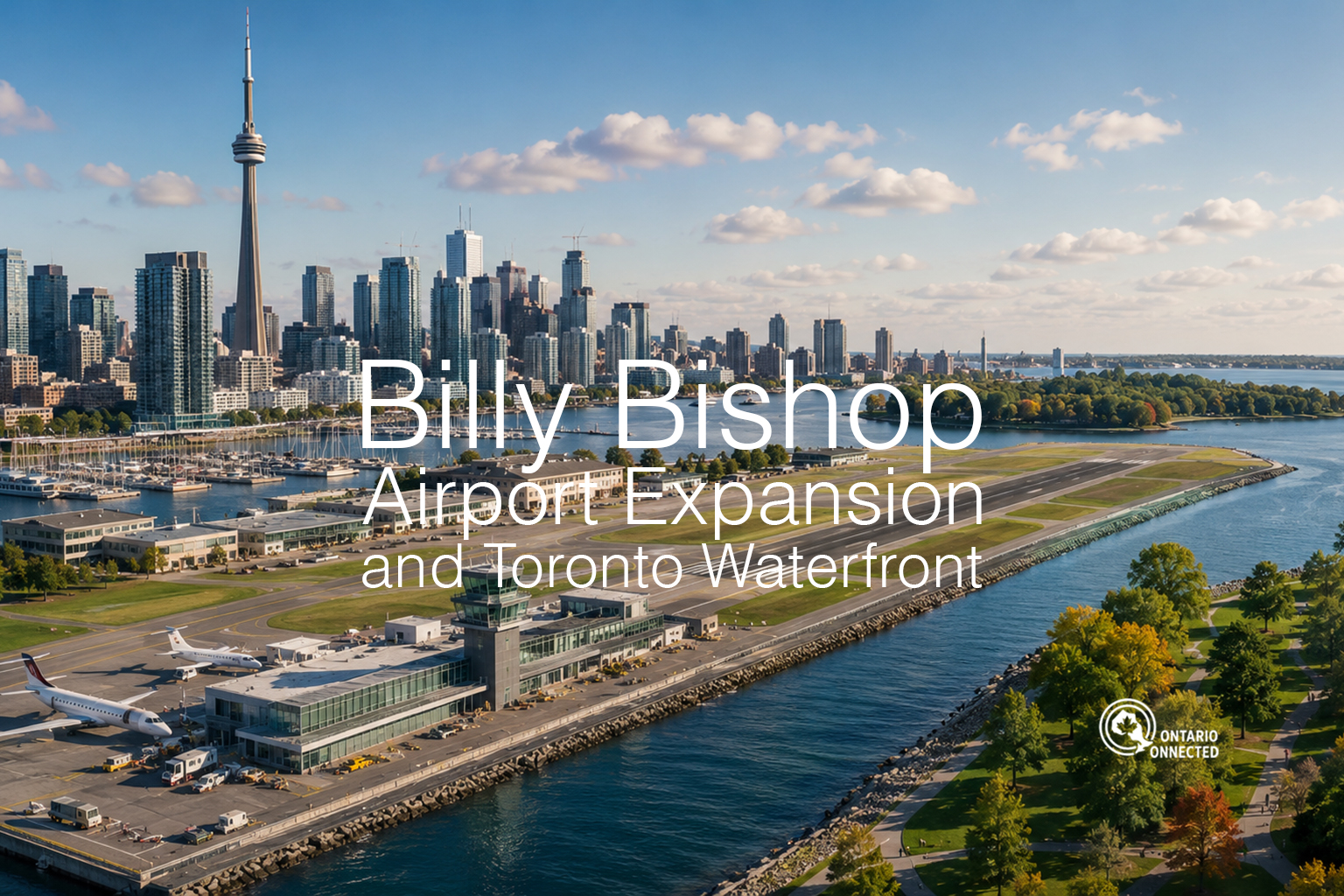
Ottawa’s rejection of the Billy Bishop Airport expansion has stopped the current effort to extend the airport’s operational runway and introduce larger commercial jets. It has not closed Billy Bishop Airport, ended its economic role or answered how Toronto and Ontario should accommodate future transportation demand.
On July 24, 2026, federal Transport Minister Steven MacKinnon announced that Ottawa would not pursue expansion plans that could infringe on public spaces such as Little Norway Park or Hanlan’s Point Beach, increase noise, cause significant environmental effects or interfere with Toronto’s ability to build housing.
The announcement followed a federal public consultation held from June 8 to July 24. More than 87,000 responses were submitted, according to reporting published after the decision.
Ottawa’s decision protects the waterfront from the expansion proposal currently being promoted. It also creates an opportunity to reconsider the airport through a wider transportation lens.
The real question is not simply whether Toronto should have more flights. It is whether expanding a physically constrained airport is the best way to improve Ontario’s connectivity when the same region is also trying to build housing, protect public waterfront space, improve transit and develop faster intercity rail.
What Ottawa Cancelled and What Will Continue
Billy Bishop Toronto City Airport operates under a Tripartite Agreement involving the federal government, the Toronto Port Authority and the City of Toronto.
The agreement regulates airport operations and prohibits commercial jets, runway extensions and additions to the airport’s land mass unless the parties agree to amend it. It also places restrictions on operating hours and aircraft noise.
The agreement was originally scheduled to expire in 2033. It was extended to December 31, 2045, primarily to allow the construction of federally required Runway End Safety Areas.
Those safety improvements are separate from the proposed commercial expansion. They provide additional protected space beyond the runway ends but do not create a longer operational runway for larger jets.
The approved safety work can therefore continue. Existing passenger services can continue. The airport itself remains open and important.
What Ottawa has rejected is the larger proposal to extend the operational runway, permit commercial jets and substantially increase the airport’s passenger capacity.
Ontario’s Expansion Effort Is Not Formally Over
The Ontario government has argued that expanding Billy Bishop would improve travel choices, attract new routes, increase airline competition, support tourism and create employment.
Ontario enacted the Building Billy Bishop Airport Act, 2026 on June 2. The legislation allows the province to take ownership of certain City-owned airport and waterfront lands and replace Toronto as a party to the Tripartite Agreement on a date set by regulation.
The provincial government has indicated that it still supports airport expansion despite Ottawa’s decision.
However, aviation is federally regulated. The federal government also owns part of the airport lands and is a party to the agreement governing airport operations. Ontario cannot independently authorize commercial jets or extend the operational runway without federal participation and other required approvals.
Ottawa’s rejection therefore prevents the current expansion proposal from advancing in its present form, even though the provincial legislation remains in force.
Billy Bishop Airport Is an Important Transportation Asset
Opposing one expansion proposal does not require dismissing the airport’s value.
Billy Bishop occupies a rare location beside downtown Toronto. It allows many passengers to reach the financial district, hospitals, universities, hotels and major employment areas without travelling across the region to Toronto Pearson International Airport.
Toronto reported approximately 1.7 million passengers at Billy Bishop in 2025. That was below the airport’s pre-pandemic level of approximately 2.8 million passengers in 2019, indicating that the airport was not yet operating at its former passenger volume when the expansion debate intensified.
A United States preclearance facility opened at the airport in March 2026. That allows eligible travellers to complete American customs and immigration procedures in Toronto before departure, improving the usefulness of existing transborder services.
The airport also supports employment, tourism, business travel and emergency medical aviation.
Its downtown location is a genuine transportation advantage. The question is how that advantage should be used without allowing the airport to overwhelm the neighbourhood, harbour and park system around it.
The Case for the Billy Bishop Airport Expansion
The strongest argument for the Billy Bishop Airport expansion is that a larger downtown airport could offer more routes and greater competition.
Aircraft permitted under the current agreement have operational and range limitations. A longer runway and permission to use newer commercial jets could make longer destinations possible and allow more airlines to compete for passengers.
For travellers starting or ending their journeys in downtown Toronto, a flight from Billy Bishop can provide a shorter ground journey than a flight from Pearson. That convenience has economic value for businesses, visitors and residents.
Supporters also argue that expansion could relieve some future pressure on Pearson. A second airport with a broader range of destinations could provide the Toronto region with additional capacity and greater resilience when weather, construction or operational disruptions affect one facility.
Construction and expanded airport activity could also create jobs and attract private investment.
These are legitimate potential benefits. They should not be rejected simply because the proposal became politically controversial.
But potential benefits are not the same as demonstrated benefits.
In its May 28 airport-expansion report, Toronto City Planning stated that it had not received a comprehensive plan, business case or detailed rationale for the proposed expansion.
Without that information, the public could not independently determine how much the project would cost, who would finance supporting infrastructure, which aircraft would operate, how many additional passengers were realistic or whether the promised benefits would exceed the wider costs.
The Case for Protecting Toronto’s Waterfront
Toronto’s waterfront is not vacant land awaiting a more profitable use.
It is expected to accommodate parks, beaches, housing, cultural institutions, environmental restoration, tourism, transportation and public access to Lake Ontario. These uses already compete for a limited amount of land and shoreline.
Toronto Island Park covers approximately 242 hectares and attracts millions of visitors. It includes natural habitat, recreational areas, ferry facilities, beaches and culturally important spaces that cannot simply be recreated elsewhere.
Hanlan’s Point also holds significant historical and cultural importance, including a long association with Toronto’s 2SLGBTQ+ community.
Little Norway Park serves residents of the Bathurst Quay neighbourhood as well as waterfront visitors. In a growing downtown where many residents live in apartments and condominiums, public parks function as shared outdoor space rather than decorative additions.
Keeping these spaces publicly accessible produces social, environmental and economic value. Waterfront parks attract visitors, support physical activity, moderate heat, improve quality of life and make dense neighbourhoods more livable.
Once public waterfront land is converted to aviation infrastructure, recovering it later would be difficult and potentially impossible.
Airport Expansion and Housing Are Connected
The effects of an airport extend beyond its runway.
Aircraft operations influence airspace, flight procedures, building heights and the use of construction cranes. Those restrictions can affect the design and financial feasibility of housing projects well beyond the airport boundary.
Toronto City Planning identified approximately 86,000 proposed residential units within areas already influenced by Billy Bishop’s existing instrument flight procedures.
Under a preliminary scenario involving a westward runway extension, the affected area could include approximately 8,200 additional homes currently in the development pipeline.
That does not mean all those homes would be cancelled. City staff stated that there was not enough information to determine how many units could be delayed, redesigned or lost.
It does show why the Billy Bishop Airport expansion cannot be evaluated as an isolated aviation project.
A change to airport operations could affect building heights, housing density, balconies, ventilation, noise mitigation and construction procedures across parts of downtown, the waterfront, the Port Lands and south Etobicoke.
Toronto should not approve an airport expansion and calculate its housing consequences afterward.
The Ground Transportation Network Is Already Constrained
An airport does not create connectivity merely by adding flights. Passengers must still reach it.
Billy Bishop’s mainland entrance is located within a constrained section of Bathurst Quay. Airport passengers, neighbourhood residents, pedestrians, cyclists, taxis, rideshare vehicles, shuttle buses, streetcars and private vehicles all depend on a limited network around Eireann Quay, Queens Quay, Bathurst Street and Lake Shore Boulevard.
Toronto’s planning report found that congestion already occurs during peak travel periods and that the surrounding geography limits opportunities to add road capacity.
A substantial increase in airport passengers would require a much larger share of travellers to use transit, airport shuttles, walking and cycling.
It would also require coordinated investment in streetcar reliability, pedestrian circulation, traffic management, curbside operations and connections with Union Station and the wider regional transit network.
Those investments would have to be included in the airport business case. They should not be treated as unrelated municipal projects to be funded later by Toronto taxpayers and transit riders.
Without a credible ground transportation plan, additional airport capacity could simply move congestion from the aviation system to the streets surrounding the waterfront.
The Environmental Effects Extend Into the Harbour
A runway extension would likely require additional lakefill. That could alter water movement through Toronto’s Inner Harbour.
Previous environmental work cited by the City found that extending the airport land mass could reduce water circulation, increase the amount of time pollutants remain in the harbour and weaken the natural flushing of water entering from the Don River and stormwater outlets.
A larger expansion could also affect marine navigation through the Western Channel, airport exclusion zones, recreational boating, water taxis, ferry access and future marine transportation services.
These effects must be considered alongside major public investments already being made in waterfront naturalization, wastewater management and the restoration of the Don River.
An airport project should not undermine environmental improvements being funded elsewhere by the same public.
Indigenous Leadership Must Be Part of Waterfront Planning
The Toronto Islands and surrounding waters hold deep cultural, spiritual and historical importance for Indigenous peoples.
The City’s planning report identifies the Mississaugas of the Credit First Nation among the First Nations connected to the Toronto Islands and surrounding shorelines. It also identifies continuing Indigenous priorities involving access to land and water, environmental stewardship, housing, ceremony, gathering spaces and cultural use.
Any future airport proposal would require transparent engagement with First Nations rights holders and other affected Indigenous communities.
For Ontario Connected, Indigenous participation should extend beyond a conventional consultation exercise. It should include meaningful opportunities for leadership, environmental stewardship, governance, procurement, employment and long-term economic participation where communities choose to pursue them.
No government should treat Indigenous involvement as a final approval step after the major project decisions have already been made.
How the Decision Relates to Ontario Connected
The airport debate demonstrates a central principle behind Ontario Connected: transportation should be planned as a connected network rather than as a collection of competing projects.
Airports, high-speed rail, regional rail, subways, streetcars, buses, roads, cycling routes and pedestrian networks perform different functions. Problems emerge when one mode is expected to compensate for weaknesses in all the others.
Pearson should remain the region’s principal international and long-distance aviation hub. Billy Bishop can continue serving regional, short-haul and transborder markets where its downtown location provides a clear advantage.
Faster intercity rail could serve many trips that currently depend on cars or short-distance flights.
Ontario Connected has proposed exploring a province-wide passenger rail network operating at approximately 200 to 300 kilometres per hour, supported by integrated stations and reliable local transit connections. This remains an Ontario Connected concept, not an approved provincial project.
Such a network would not eliminate aviation. It could reduce pressure to expand a constrained waterfront airport simply because travel between Ontario cities remains too slow or inconvenient.
For a journey between downtown Toronto and another major city, the relevant comparison is not the maximum speed of an aircraft against the maximum speed of a train.
The proper comparison is the complete door-to-door journey: travel to the airport or station, check-in and security, waiting time, boarding, possible delays, arrival procedures and transportation to the final destination.
A downtown rail station can compete effectively with air travel on suitable routes even when an aircraft travels faster once airborne.
Ontario needs to decide which journeys should be served by aviation, which should be served by rail and how both systems should connect with local transit.
The Costs of Keeping the Airport Within Its Current Limits
Protecting the waterfront is not a decision without trade-offs.
Keeping the existing runway and aircraft restrictions may limit the number and range of destinations that can be served from Billy Bishop. It may also limit airline competition and place more future passenger demand on Pearson.
Some potential construction, tourism and aviation employment associated with expansion may not materialize.
Passengers travelling from downtown to destinations that cannot be served from Billy Bishop will continue to spend additional time reaching Pearson.
These disadvantages are real. A serious waterfront policy should acknowledge them rather than claiming that stopping expansion creates no economic cost.
The question is whether those costs are greater than the housing, environmental, transportation and public-space consequences of expansion.
That comparison could not be completed responsibly without a detailed proposal and transparent business case.
A Practical Direction for Billy Bishop Airport
The choice should not be limited to unrestricted expansion or allowing the airport to decline.
The immediate priority should be completing the approved runway safety work while keeping the distinction between safety improvements and commercial runway expansion clear.
The airport should make effective use of its new United States preclearance facility and the capacity already permitted under the Tripartite Agreement.
Ground access can be improved through more reliable transit connections, better shuttle operations, safer walking and cycling routes and stronger integration with Union Station and regional transportation services.
The airport can continue reducing its local effects through quieter operations, electric ground equipment, improved scheduling, reduced vehicle idling and transparent monitoring of noise and air quality.
Governments should also examine how future aircraft technology may improve the airport’s usefulness without requiring the most damaging forms of physical expansion.
Any renewed proposal to extend the operational runway or introduce commercial jets should begin with a publicly available plan. That plan should identify realistic passenger demand, financing, aircraft types, economic benefits, housing consequences, ground transportation requirements and environmental effects.
It should include independent analysis of noise, public health, water circulation, habitat, marine navigation and climate impacts.
It should also define how public parks, beaches, community facilities and waterfront access would be protected before governments make an approval decision.
Connectivity Should Not Require Sacrificing the Waterfront
Ottawa’s rejection of the Billy Bishop Airport expansion does not resolve Ontario’s transportation challenges.
The province still needs better connections between Toronto, the Greater Toronto and Hamilton Area and communities across Ontario. Pearson will still face long-term growth. Intercity rail remains inadequate for many journeys. Local transit connections to major transportation hubs still require improvement.
But the absence of a complete transportation network does not justify placing every new demand on one airport surrounded by housing, parks, beaches and a working harbour.
Billy Bishop should remain an important part of Toronto’s transportation system. Toronto’s waterfront should remain a public, environmental and cultural asset. Faster regional rail, high-speed intercity rail and stronger local transit can make those objectives compatible.
The lesson from Ottawa’s decision is not that Ontario must choose between connectivity and conservation.
It is that major transportation decisions must be supported by evidence, coordinated across modes and evaluated against their full consequences.
Ontario does not need one project to defeat another. It needs a connected network in which airports, railways, transit systems, housing and public spaces are planned together.






Leave A Comment
You must be logged in to post a comment.