
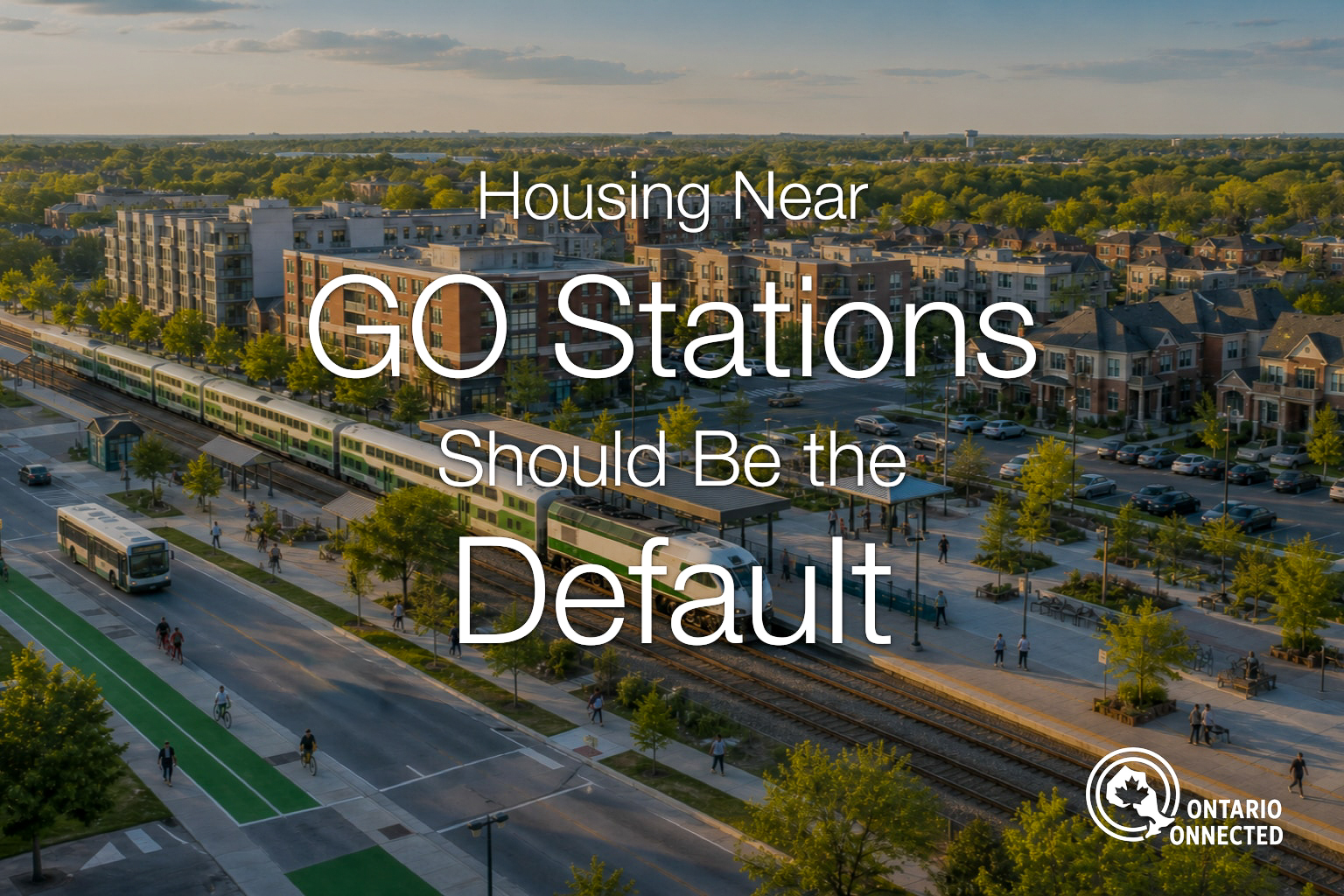
Housing near GO stations should be one of the easiest decisions Ontario makes.
We are spending billions to run more trains, improve stations, and turn GO Transit into an all-day regional network. Yet at many stations, the first thing riders see is still a wide field of asphalt. People step off a train, walk past hundreds of parked cars, and continue to homes, shops, schools, and services located kilometres away.
We built the railway, but too often we stopped before building the community around it.
That is beginning to change. Ontario’s transit-oriented communities program now includes plans for thousands of homes near GO, subway, and LRT stations. The numbers are large enough to matter. In April 2026, the province announced that the planned community near Oakville GO Station would support more than 6,800 homes, almost 4,000 construction jobs, and roughly 400 permanent jobs.
Ontario says similar projects across the Greater Golden Horseshoe could eventually support up to 292,000 homes and more than 84,000 jobs.
Those numbers raise an obvious question. If this works at Oakville, Guildwood, Clarkson, Cooksville, and Mount Joy, why is it not the standard plan for every suitable major station?
Why housing near GO stations makes sense now
GO Transit was designed mainly around the traditional commute: into Toronto in the morning and back out in the evening. Large parking lots made sense within that model. The station was a transfer point between a car and a train, not the centre of a neighbourhood.
GO Expansion changes that logic.
Metrolinx says the expanded network is being built to support trains every 15 minutes or better, all day and in both directions on core parts of the Lakeshore East, Lakeshore West, Kitchener, Stouffville, and Barrie lines.
A station with frequent service is more than a commuter stop. It can connect people to jobs in either direction. It can support evening trips, weekend travel, appointments, shopping, and education. It becomes useful throughout the day instead of filling up at 7 a.m. and emptying after dinner.
That kind of transit deserves a different kind of land use around it.
A family living beside a GO station may need one car instead of two. A student can reach school without being driven. A senior can get to an appointment without depending on a relative. A worker can consider jobs in more than one city without accepting a punishing daily drive.
The payoff is the time people get back, not the condo tower by itself.
A train station should not be an island of asphalt
Surface parking is cheap to understand. It is also an expensive use of land once a station becomes one of the best-connected places in a municipality.
One parking space holds one empty car for most of the day. The same land, planned properly, can support homes, a grocery store, a day care, public space, and better bus connections while preserving parking for riders who still need it.
Ontario Connected has already made the case for transit hubs that function as living centres, not bare platforms surrounded by long walks and parking lots. The province’s current plans show that this idea can move beyond drawings and become actual housing policy.
The official station proposals give a sense of what is possible:
- approximately 2,500 homes at Guildwood GO
- approximately 2,715 homes at Aldershot GO
- approximately 2,400 homes at Clarkson GO
- approximately 6,880 homes at Oakville GO
- approximately 3,000 homes at Cooksville GO
- approximately 5,500 homes near Milliken GO
These are not small infill projects. Together, they can reshape where growth happens across the region.
The alternative is familiar. We push new housing farther from established transit, extend roads and pipes outward, and then wonder why congestion gets worse. Families may find a home, but they pay for the distance in fuel, car payments, insurance, and hours lost behind the wheel.
Oakville shows the scale
The Oakville plan matters because it is tied to a station people already use.
Oakville GO is the second-busiest station on the Lakeshore West line after Union Station, according to the province. The proposed community includes homes, jobs, parks, bike paths, a day care, and improved walking access to the station.
That is what transit-oriented development is supposed to look like. The train is not added after the neighbourhood is finished. It is the reason the neighbourhood can support more people with fewer car trips.
There will be arguments over building heights, traffic, construction, and local services. Those concerns are real. The answer is better planning, not retreating to a parking lot because it attracts fewer meetings.
Growth is coming to Oakville and the rest of the Greater Golden Horseshoe. The choice is where it goes and how much infrastructure each new home requires. Homes beside regional rail use an investment Ontario has already made. Homes on the far edge of a municipality often require another round of road widening before the first residents have finished unpacking.
Parking still matters
People drive to GO stations for good reasons. Many live beyond practical walking distance. Local buses may be too infrequent, the first train may leave before feeder service begins, or a shift may end after the last useful connection.
Taking parking away before those connections improve would leave some riders stranded.
Freezing every surface lot in place for the next 30 years makes no sense either.
The sensible way through is phased redevelopment. Build structured or underground parking where the numbers support it. Protect accessible spaces and short-term pickup areas. Improve bus bays, bike storage, sidewalks, and safe crossings before closing sections of a lot. Develop one parcel at a time so the station continues to work during construction.
Drivers do not need to be pushed out. The land simply needs to do more than store cars.
Affordability has to be part of the deal
There is a risk in every major transit project. Public investment makes land more valuable, private development follows, and the people who most need transit cannot afford to live nearby.
Ontario should not call a project a complete community if it produces only expensive one-bedroom units.
Public land and public approvals give governments leverage. Agreements should include purpose-built rental housing, affordable units, family-sized homes, and accessible housing for seniors and people with disabilities. The mix will vary by station, but affordability cannot be left to a future council or a voluntary promise.
This matters because transportation is part of the cost of living. A cheaper home far from work can become expensive once a household needs two vehicles. Ontario’s affordability problem is not limited to rent or mortgage payments. It includes the cost of reaching a job, school, groceries, health care, and family.
Housing near GO stations can reduce that burden, but only if ordinary workers can live there.
The station has to work as a neighbourhood
Putting towers beside a platform is not enough.
People need to cross the street safely. Children need schools and day care. Seniors need benches, shade, and winter maintenance. A station area needs a grocery store that people can walk to, not another isolated retail plaza across six lanes of traffic.
Local transit matters just as much. A frequent train loses much of its value when the connecting bus comes every 40 minutes. Municipal bus routes should be planned with GO schedules, and service should continue into evenings and weekends as the rail network becomes more frequent.
This is where the idea of work-live communities becomes practical. A person should be able to live near one station, work near another, and handle much of daily life without driving back to a highway interchange for every errand.
The station must be part of the street, not fenced off from it.
What Ontario should do next
Ontario already has a policy and several strong station proposals. GO Expansion makes those locations more useful. The next step is to apply the approach consistently across the network.
- Publish a station-by-station land plan for major GO corridors, including publicly owned parcels and large surface parking areas.
- Set housing, employment, public-space, and affordability targets for every suitable station.
- Replace surface parking in phases while protecting access during construction.
- Tie provincial approvals to municipal plans for water, schools, parks, local transit, and pedestrian safety.
- Require a meaningful mix of rental, affordable, accessible, and family-sized homes when public land is involved.
- Report progress publicly so residents can see which projects are approved, funded, delayed, or under construction.
This does not require every station to look like downtown Toronto. A smaller town may need mid-rise housing, townhomes, a clinic, and better bus service. A major station such as Oakville or Cooksville can support much more. The point is to plan each station as a place where people live, not only a place where they leave a car.
The rule should be simple
Ontario does not need another study to prove that homes belong near frequent transit. The province’s own plans already make the case.
The Oakville project alone could add more than 6,800 homes beside an existing GO station. Across the wider program, the province sees room for up to 292,000 homes. Meanwhile, Metrolinx is building a network intended to carry more people, in both directions, throughout the day.
Spending on frequent rail while leaving the station district underused is a half-finished job.
Build the homes where the trains already go. Keep station access for drivers who need it, but stop treating flat parking lots as the permanent highest use of some of Ontario’s best-connected land.
Housing near GO stations should not be a special project that appears in a news release once or twice a year. It should be the default.
Quick take
GO Expansion is intended to bring frequent, all-day service to core routes. Ontario’s transit-oriented communities program could support up to 292,000 homes near transit. The province should keep moving in that direction, replace surface parking carefully, protect station access, and require housing that regular workers and families can afford.
Ontario already has the right idea. Now it needs to apply it across the network.






Leave A Comment
You must be logged in to post a comment.