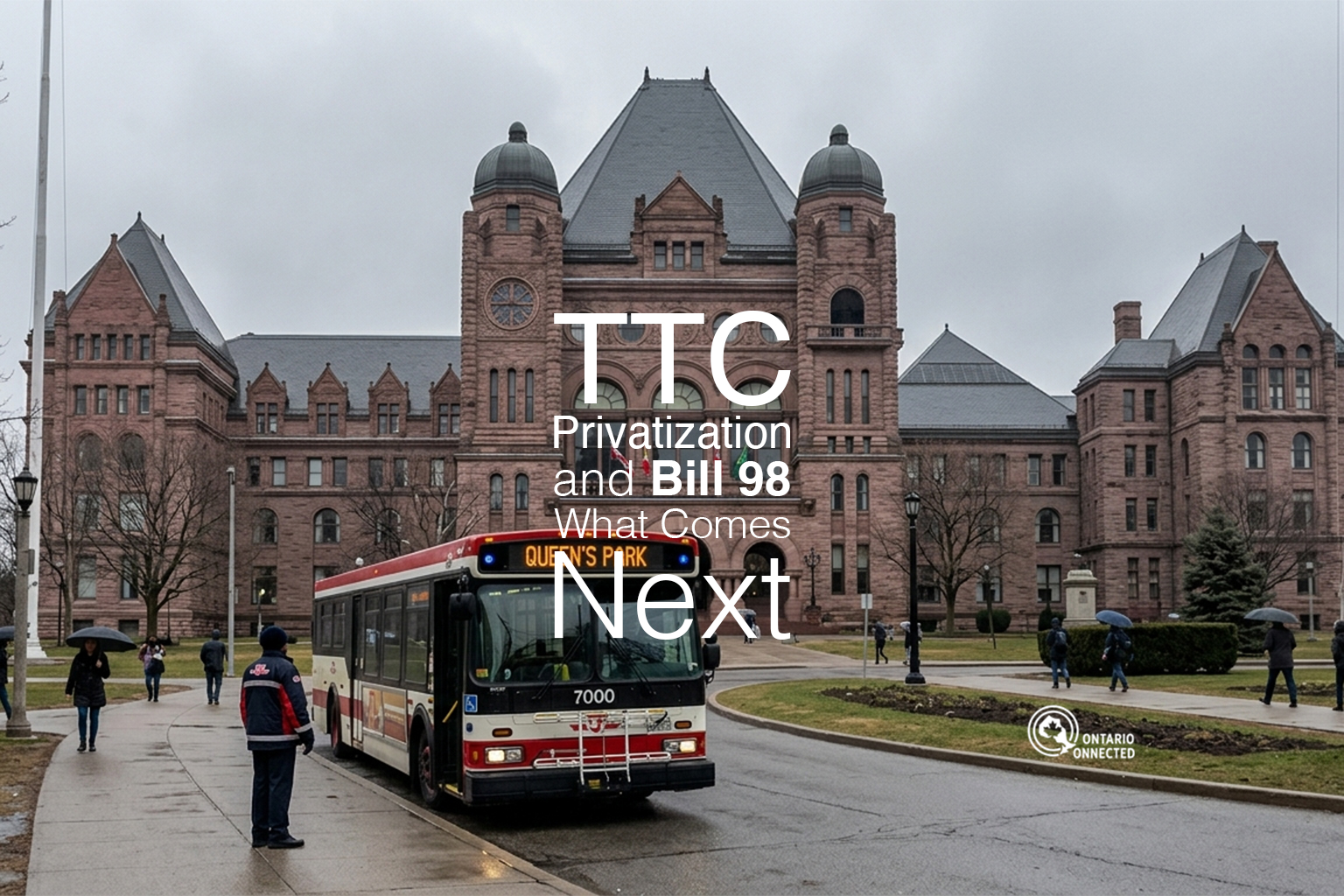
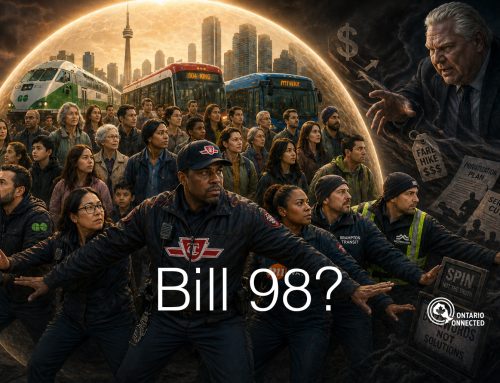
Bill 98 is passing. The fight to stop TTC privatization starts now.
ATU Local 113 went to Queen’s Park this week. The legislative committee was hearing from the public on Bill 98. The union was clear about where things stand: Ford has the majority. Bill 98 is going to pass. And TTC privatization is what the union expects to follow, written into the regulations once the province has the authority to do it.
I drive trains on Line 1. I’m an ATU member. The people being talked about in these regulatory proposals aren’t abstract workers in a policy document. They’re operators on cross-boundary bus routes who’ve spent careers inside a public transit system. What gets written into those regulations will land on them first.
What happened at Queen’s Park
President Marvin Alfred laid out the union’s position plainly: keep transit public, keep it under democratic local control, keep the revenue in Toronto. He asked for the bill’s powers to be limited to cross-boundary bus routes only, and for any fare changes to come with a compensating subsidy so no agency loses ground.
TTCriders joined them. The riders’ advocacy group sent members to speak about what the bill means for the people using the system every day: fare increases are coming, service cuts are possible, and nothing in the legislation is written to prevent either.
Then TTC CEO Mandeep Lali stood up. The person running the TTC, standing with the union and with riders, calling for protected local service and a reliable operating subsidy from the province. Management and labour at the same microphone. That doesn’t happen often. When it does, it’s worth paying attention.
TTC privatization is already in the plan
NDP transit critic Tom Rakocevic is putting forward amendments this Friday. Liberal transit critic Andrea Hazell is pushing alongside him. Ford has a majority government.
The math on those amendments is not good.
What comes after the bill passes is the regulations. ATU has already named what they expect: fares based on zone or distance, and TTC bus routes contracted out to private operators. That’s TTC privatization. Not a hypothetical buried in fine print. A specific outcome the union is already preparing to fight.
Zone fares would mean a rider in Scarborough pays more to travel the same system as someone downtown. The bill calls that integration. Most riders would call it a penalty for living in the wrong part of the city. For the operators running cross-boundary routes, contracting out means the collective agreement, the pension, the safety standards built through a century of bargaining are all on the table. Whatever a private operator offers is what replaces them.
What it looks like from Line 1
The first Bill 98 article laid out what the legislation actually does: Schedule 4 gives the Minister of Transportation control over fares, revenue, routes, and service standards province-wide. No worker protections. No service level minimums. Authority, waiting for regulations.
I’m not on the routes being targeted right now. I run trains. But the operators on the 32, the 960, the corridors connecting Toronto to Mississauga and Brampton every day are ATU members. When the regulatory proposals land, they won’t get much warning. TTC privatization moves fast once authority is in place and nobody has agreed in writing on what it cannot do.
Decisions get made somewhere else. People find out after.
What to watch for
The real fight starts when the province releases its regulatory proposals. That’s when the fare models get published, when the contracting-out plans go official, and when TTC privatization stops being a prediction and becomes a formal proposal on paper. That’s also when the union has something specific to push against in public.
The coalition ATU built at Queen’s Park, workers, riders, and the TTC’s own CEO, has more weight going into that regulatory fight than the union would have alone. That combination matters.
The case this site has been making for over a year is a transit system built on stable public funding and real accountability. Fragmented planning with authority concentrated at the province has a track record in Ontario. It doesn’t produce better service. It produces downloaded costs and workers absorbing cuts they didn’t create.
Bill 98 is passing. What gets written into the regulations, and who’s in the room when that happens, is the question now. ATU has said they’re staying in the fight. So have the riders. So has the CEO of the TTC.
Watch the regulations.
Quick take
Bill 98 is going to pass. ATU, TTCriders, and the TTC’s own CEO all went to Queen’s Park and made the case against it. Ford has the votes. What follows is a regulatory process the union expects to produce zone fares and TTC privatization of cross-boundary bus routes. The coalition that came together at Queen’s Park goes into that fight next. That’s where this is headed.
Ontario Connected is an independent research and advocacy platform. The views are my own analysis of public policy, intended to inform civic, labour, and government conversations about Ontario’s transit future.
Sources: ATU Local 113, wemovetoronto.ca, May 2026 · Bill 98, Legislative Assembly of Ontario


Leave A Comment
You must be logged in to post a comment.